Technological advancement has made critical tasks easier. Among the recent tech breakthroughs, edge computing and artificial intelligence (AI) are surely significant. Edge AI combines both technologies by executing machine learning functions directly on interconnected edge devices.
Edge AI adoption has experienced significant growth lately. In 2024, the global edge AI industry reached a valuation of $27 billion. The equation is about to surpass $269 billion by 2032. Businesses across the world are aiming to streamline their workflows as efficiently as possible. Edge AI contributes to this purpose notably.
In this blog, we’ll explore the importance of edge AI in modern-day business, top edge AI platforms, features, and the methods to choose the best tools. Let’s begin...
What is Edge AI?
In simple terms, edge AI is the integration of artificial intelligence across edge devices in the real world. Here, the AI computation takes place at the edge of the network, near the user, and where the data is located. It eliminates the need for centralized cloud computing facilities and private data centers.
Edge computing helps in processing AI algorithms with or without an internet connection since it enables data to be stored near the device location. As a result, data processing becomes faster alongside initiating real-time feedback.
Examples of devices with edge AI integration are wearable devices like smart watches, self-driving cars, smart home appliances, and other IoT devices. The merger of edge computing and AI allows such devices to operate with or without an internet connection while generating real-time information.
Importance of Edge AI-
As the adoption of connected devices surges, the importance of edge AI automatically increases. Edge AI not only helps with data processing in edge devices near the user but also offers low latency and real-time decision-making. Here are the key benefits of Edge AI-
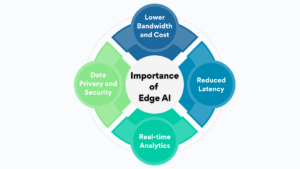
Lower Bandwidth and Cost: Since edge AI enables data processing in local devices, it lessens the need for a huge amount of data processing, analysis, and storage. It not only leads to limited internet bandwidth consumption but also reduces costs.
Reduced Latency: Edge AI platforms make data processing and transmission faster since they analyze it locally. The functionality makes decision-making quicker.
Real-time Analytics: With edge AI, users can enable real-time data processing and analytics without any significant need for system connectivity. This helps to meet the users’ needs in real time.
Data Privacy and Security: In edge AI-enabled devices, data transfer over another network is unlikely. So, the data processed and stored remains protected from possible threats.
Best Edge AI Platforms:
NVIDIA Jetson:
NVIDIA is a global tech leader that advances AI-enabled workloads with sophisticated GPUs. NVIDIA Jetson is an efficient edge AI platform, designed specifically for IoT, robotics, and autonomous systems. It enabled GPU-accelerated computing that conveniently executes complex AI workloads.
Jetson also integrates JetPack SDK for streamlined development and real-time computer vision. However, it can cost a lot, and beginners may find it complex to operate while getting started.
AWS Edge Services:
AWS IoT Greengrass and SageMaker Edge are segments of AWS Edge Services. These integrate scalable and efficient AI deployment on the edge devices of users. The AWS Edge Services come with AWS cloud integration and model optimization for minimum latency. It also enforced with Amazon’s robust security framework that helps edge devices operate in a risk-free way.
Enterprises rely on AWS Edge Services due to their high scalability and reliability. Nevertheless, it offers limited support to non-AWS hardware.
Google Edge TPU:
Edge TPU of Google runs TensorFlow Lite Models on Edge Devices. It is a hardware-accelerated platform that is suitable for robotics and IoT. It integrates a high-performance Tensor Processing Unit (TPU) for inference. Alongside that, it is compatible with Google Cloud for hybrid deployments.
Google Edge TPU offers cost-effective hardware options and is developer-friendly. One of its drawbacks includes the requirement for Google Cloud for advanced features.
Edge Impulse:
Edge Impulse is one of the advanced edge AI platforms for ML model development and deployment on edge devices. It enabled data acquisition and reprocessing tools for diverse types of data. Edge Impulse also unlocks real-time model testing that offers opportunities for improvement. The platform further enabled collaboration tools for better team performance.
Edge Impulse offers higher hardware compatibility. However, it has limited advanced customization options for complicated use cases.
How to Choose the Best Edge AI Platform?
Aspects such as organization size, target industry, technical requirements, and budget play significant roles in choosing the appropriate edge AI platform for your business.
Assess Your Business Size and Needs: First of all, assess your organization’s size and its specific needs to fulfill. If your needs are simplified, then platforms with less complicated architecture can be helpful.
Identify Your Hardware Requirements: Understand the level of processing power your edge devices need. It will help organizations comprehend the hardware requirements and the operating environments.
Analyze Platform Features: While assessing the best edge AI tool for your business, considering its features and existing tech stack is important. Moreover, scalability and security are two other aspects that need to be considered.
Determine Your Budget and The Cost: Investment in edge AI platforms should reflect positive returns. Hence, determine a budget that doesn’t impact the overall financial structure of an organization. Alongside that, assess which platform fits into your budget.
Concluding Remarks!
Connected devices are being implemented across industries, including healthcare, retail, manufacturing, and others. Hence, the demand for edge AI will grow exponentially in the coming years. Businesses operating across these industries must assess their budgets, hardware requirements, and operating environments before choosing the appropriate edge AI platforms.
Read our in-depth blogs for unmatched insights on emerging technologies and innovations.
F&Qs:
1. What is an example of edge AI?
Answer: Real-time navigation in autonomous vehicles is an example of edge AI.
2. Which edge AI platform is best?
Answer: NVIDIA Jetson, AWS Edge Services, Google Edge TPU, and Edge Impulse are among the top edge AI platforms.
Must‑read:
Artificial Intelligence for Edge Computing
The Synergy of Edge, Cloud, and 5G Technologies in Smart AIoT Networks