AI chatbots have surely redefined the way organizations manage their internal and external communications. While offering 24/7 availability, these tools have made information access, customer support, and workflow automation remarkably easy. IT and HR are among the leading sectors that have adopted AI chatbots with a remarkable impact.
Enhanced integration across industries has been a primary reason for the quick growth of the AI chatbot market. The global AI chatbot industry was valued at $15 billion in 2024 and is expected to exceed $46 billion by 2029. Reports find that over 53% of organizations use AI chatbots for IT support. Apart from that, over 50% of HR leaders have actively implemented AI chatbots to streamline HR processes.
In this blog, we’ll understand how the implementation of AI chatbots for internal IT and HR support has been revolutionized. First, let us get a clear picture of the emergence of AI chatbots.
Emergence of AI Chatbots:
Chatbots have become an integral part of businesses today. However, it is not a technology that gained popularity overnight but an innovation with years of efforts and continuous advancements in artificial intelligence, natural language processing, and user‑centric design.
While tracing the early roots of chatbots, we find that in 1966, the renowned computer scientist Joseph Weizenbaum introduced the very first chatbot, ELIZA. The chatbot was capable of responding to simple commands by asking basic questions. ELIZA’s responses were keyword-based.
Gradually, PARRY was introduced in 1972, Jabberwacky came in 1988, and ALICE became popular in 1995. These were chatbots gaining attention before the Internet age. With rapid evolution in AI and natural language processing, chatbots have become increasingly efficient. Gradually, these have become personal assistants to professionals and support assistants for organizations.
Today, firms across sectors implement these bots for customer support, sales, and even internal communication. Using AI chatbots for internal IT and HR support enables organizations to address internal issues of companies effectively, better employee workflow management, and improved productivity.
Importance of AI Chatbots in IT and HR-
AI chatbots play a crucial role for IT and HR teams. While addressing repetitive tasks, chatbots can support IT and HR professionals 24/7. Availability is essential for both IT and HR while reinforcing the technical and people-centric elements in an organization.
The implementation of chatbots allows IT and HR teams to empower an entire organization with the timely availability of insights while tackling challenges and unlocking internal support. The bots work as personal assistants to professionals within organizations, contributing to improved productivity, positive employee experience, and consistency. Let us discuss the major benefits of IT and HR.
Benefits of AI chatbots in IT:
IT helpdesk support: AI chatbots help IT teams to address minor technical issues like software installation, password reset, and real-time assistance.
Self-service guidance: Chatbots are available round the clock and offer self-service guidance to employees in an organization. So, they can resolve small technical glitches by themselves.
IT service and resource management: While chatbots make important services and resources easily available, which helps in quick troubleshooting even when IT professionals are not around.
Benefits of AI chatbots in HR:
Instant support: AI chatbots provide employees with quick responses to queries about the organization, its policies, and related matters. Moreover, AI bots offer support around the clock, so employees can get instant responses anytime they want.
Enhanced employee experience: The instant and round-the-clock support contributes to enhanced employee experience. Additionally, it offers personalized responses that help employees get exactly the insight they seek.
Reduced operational costs: It reduces the overall workload of the HR department in an organization, which limits the requirement for headcount and operational needs. It helps streamline HR operations at limited costs.
Use Cases of AI Chatbots for Internal IT and HR Support-
AI chatbots can streamline several aspects of IT and HR workloads. Among them, onboarding and offboarding include efforts from both IT and HR, which AI chatbots can automate, saving time and effort. Let us discuss the distinguished use cases of AI chatbots in IT and HR:
IT-
Automated Ticket Management:
AI chatbots for internal IT support enable automated and intelligent ticket management. The chatbots classify, prioritize, and route tickets and issues with the appropriate IT specialist while improving efficiency.
Appropriate Awareness and Education:
IT processes require adequate knowledge and awareness for disruption-free workflows. AI chatbots can help IT professionals and other team members gain actual awareness and education on the dynamics of IT processes.
Automated Monitoring and Troubleshooting:
IT teams have to continuously monitor the software, hardware, and endpoints within an organization. AI chatbots enable automated monitoring and reporting, which helps in quick troubleshooting and risk mitigation.
Streamlined Onboarding and Offboarding:
Chatbots simplify the onboarding and offboarding of accounts and tools, alongside provisioning them. Manual onboarding and offboarding require significant time and effort. Additionally, these are multi-step processes, automating which saves time, effort, and human intervention.
HR-
Timely Policy and Benefits Update:
HR policies are core documents within an organization, and every employee should be aware of them and adhere to them. AI chatbots make the key insights from HR policies always available for employees. Alongside that, chatbots also help employees understand the benefits they can get during their tenure in an organization.
Efficient Performance Management:
AI chatbots enable continuous employee feedback and highlight their key responsibilities. Apart from that, chatbots monitor employee performance, conduct reviews, and track milestones.
Consistent Support and Engagement Analysis:
AI chatbots reduce the need for consistent manual HR support. Employees can resolve general queries about HR protocols and organizational guidelines using chatbots. Additionally, it helps assess employee engagement while carrying out regular feedback surveys.
Guide to Use AI Chatbots for Internal IT and HR Support:
Implementing AI chatbots for internal IT and HR support includes multiple stages. Every stage requires precision and close monitoring. Here are the stages to follow-
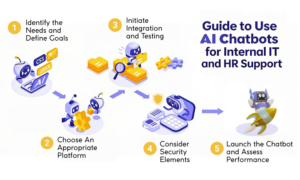
1. Identify the Needs and Define goals:
Primarily, understand the core requirements in IT and HR that you need AI chatbots for. Additionally, it is also crucial to define the goals beforehand. Such an approach makes the deployment of chatbots easier and more efficient.
2. Choose An Appropriate Platform:
It is important to choose the right platform to build your chatbots for IT and HR. Unaligned goals between you and the platform can lead to the creation of inefficient chatbots. The platform must offer adequate resources and technical support to create chatbots that can actually address employee queries, simplifying IT and HR processes.
3. Initiate Integration and Testing:
After you choose the right platform and build the chatbot, integrate it into the IT and HR processes alongside testing. Make sure the functionalities of the chatbots and the internal components, including software, hardware, and resources, are in place for seamless operations.
4. Consider Security Elements:
Make sure to integrate robust firewalls to protect the chatbots from cyber attackers. Since AI chatbots will manage internal communication and information exchanges, they are at high risk of being targeted by attackers. So, implementing strong security strategies is unignorable while using AI chatbots for internal IT and HR support.
5. Launch the Chatbot and Assess Performance:
Launch the AI chatbot and start tracking its performance. Assessing performance will offer opportunities to identify weak areas and make necessary changes for the betterment of the chatbot.
In Conclusion:
Adopting AI chatbots in IT and HR processes can be highly beneficial when it comes to automating and streamlining major functionalities. However, it is crucial to consider the costs, compatibility, and security elements of chatbots. Alongside that, it is necessary to impart necessary training to every employee to use the AI chatbots for IT and HR effectively.
Do not forget to read our other informative blogs to stay aligned in the tech-driven era!
FAQs:
1. What are the AI chatbots?
Answer: AI chatbots are software tools that can initiate human-like conversations through text and voice. Chatbots are enabled with artificial intelligence, machine learning, and natural language processing.
2. What are the top 3 AI chatbots?
Answer: OpenAI’s ChatGPT, Google’s Gemini, and Anthropic’s Claude are the top three AI chatbots.
3. What are the 4 main types of AI?
Answer: Reactive machines, limited memory AI, theory-of-mind AI, and self-aware AI are four major types of AI, classified by their functionality and capabilities.
Recommended For You:
Is ChatGPT Only for Everyday Discussions? We’ll find out!'
A Timeline of OpenAI’s Technology and History: How OpenAI Changed the World