Virtual Reality (VR) feels like a fictional concept made real. Who would’ve thought that with simple devices like VR headsets we’d be able to reach the moon, or engage in a sword fight with historical figures?
The origins of VR can be traced back to the 1960s to computer scientist Ivan Sutherland. He created the first prototype Head-Mounted Display (HMD) that could present wireframe graphics. VR has evolved drastically since then.
Research suggests that virtual reality may raise the global economy by $450.5 billion by 2030.
By the end of this blog, you’ll gain an understanding of immersive technology and its features, including how VR headsets work.
What are VR Headsets?
Before we discuss how VR headsets work, let us first understand what VR technology is.
Virtual Reality (VR)
Virtual Reality (VR) technology is an immersive technology where users can enter a computer-generated environment and engage with it in real-time. This is done with the help of VR headsets, screens, and lenses.
VR Headsets
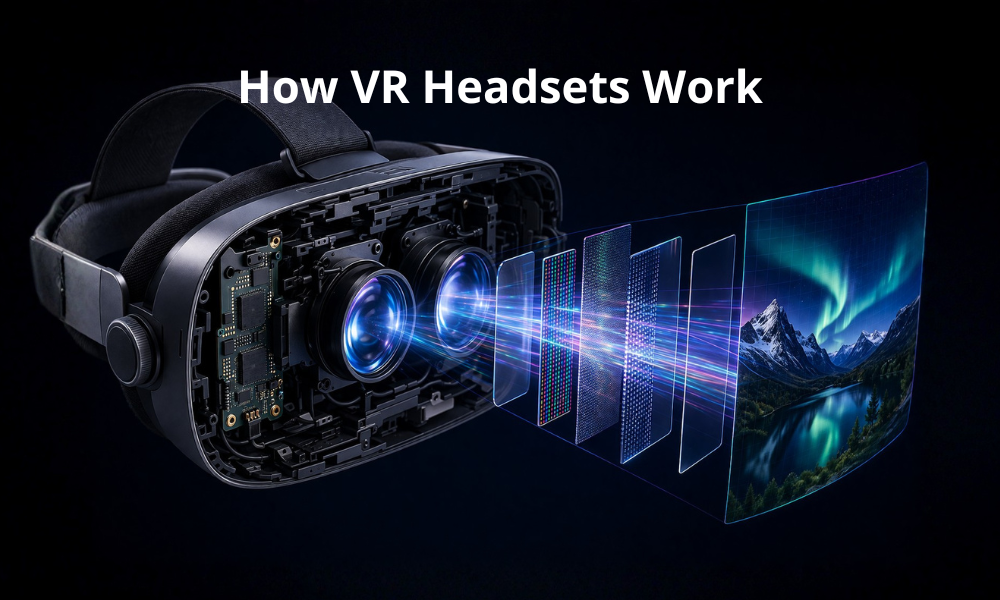
A VR headset is also known as a head-mounted display, as it is a head-mounted device that lets users immerse themselves in virtual environments. It mainly consists of a pair of lenses, screens, and a strap to secure the device to the eyes and head.
Parts of a VR Headset
To explore how VR headsets work, we need to understand their core components:
- Display screen: The display screen mostly uses high-resolution OLED or LCD panels. These screens display stereoscopic images. These images create a three-dimensional effect by showing slight changes in the angles of the same image in each eye. This creates an illusion of depth and space.
- Lenses: Lenses are placed between the user’s eyes and the display screen. Their role is to focus the images on each eye. They also expand the pictures to fill the user’s field of vision to create a compelling 3D environment.
- Sensors: Gyroscopes, accelerometers, and cameras are used as built-in sensors to track head movements and rearrange the positions of the images in the VR headset.
- Controllers: Handheld controllers or gloves detect hand and finger movements which can be used to alter virtual environments in real-time. Some of these devices also permit full-body tracking, eye-tracking, or even voice commands.
- Audio setup: The inclusion of audio enhances the immersive experience. The headsets include built-in earphones or headphones providing spatial audio. These deliver sounds as heard in the real world, taking directions and distance into consideration.
- Haptics: Some headsets come with gloves or suits that add tactile elements such as vibrations and force feedback.
- Connection: New VR headsets can be used as standalone devices or can be connected to computers and gaming consoles. These devices require strong computing capacity to contain virtual worlds. Tethered headsets use HDMI or USB cables to connect to PCs or consoles. Standalone devices have their own processing power.
How VR Headsets Work?
By now, you may be curious about how VR headsets work. These headsets combine three main human senses to create a fully immersive experience: visibility, audibility, and tactility.
Visibility
VR headsets generate stereoscopic images to create 3D visuals. They display the same image from different angles for each eye to create a perspective of distance, solidity, and depth.
Head-tracking motion sensors are used to make the visuals feel more realistic by adjusting the virtual world to head movements. This is made possible by accelerometers that measure variations in velocity, gyroscopes that trace rotational movement and orientation, and magnetometers that detect magnetic fields using directional navigation.
Audibility
To make the experience more immersive, VR headsets have built-in 360-degree spatial audio systems. These enhance the sounds by making them seem as though they are coming from specific directions. The sound could be a voice behind you, footsteps to your left, or even a strong breeze a distance away.
Tactility
Tactility is determined by input controllers that have built-in haptic feedback. These can be worn as gloves or full bodysuits and vibrate when you interact with objects in the virtual world. For instance, if you hold an object in the real world, the controller can adjust the intensity of the vibrations to simulate the real texture and weight of the object. Or, if you accidentally bump into something in the digital world, you may feel a jolt from the controllers.
VR Headsets Use Cases
VR technology can be used in almost all industries. The examples below are just a few of them:
- Gaming: Perhaps the most popular application of VR can be found in gaming. It allows gamers to fully immerse themselves in virtual gaming environments, letting them experience the game as a character literally inside the world.
- Education: VR enables students and professionals to safely simulate educational experiences. Medical students can decrease errors by practicing surgeries through simulations. Pilots can train through flight simulations.
- Healthcare: VR can be helpful in diagnosing and treating medical conditions, such as psychiatric conditions. For example, patients with phobias can overcome their anxiety by facing their fears using VR in exposure therapy.
Virtual Reality in the Modern Age
Now you know all about this immersive technology and how VR headsets work.
VR headsets help set the scene using stereoscopic imaging to create 3D environments. Built-in spatial audio adds the element of sound, increasing the reality of virtual worlds. Controllers in gloves and bodysuits complete the experience by adding the sense of touch. All of these come together to make VR a modern and innovative technology with practical applications across industries.
Click here to read how virtual reality is being used in tourism and here to explore more blogs.
FAQs
1. Can VR headsets cause discomfort to users?
Answer: Yes, VR headsets may cause discomfort such as eye strain, headaches, and motion sickness, particularly if they are used for a long period of time.
2. Do VR worlds actually feel real?
Answer: Yes, VR headsets make VR worlds feel real by creating depth using stereoscopic images, using spatial audio, haptic feedback, and motion-tracking sensors to simulate tactile sensations.
3. Where else can VR be used except for gaming?
Answer: VR can be used in a variety of industries, such as education and healthcare. Medical students can perform mock treatments on simulated patients, and pilots can train by using flight simulations.
Recommended For You:
Virtual Reality in Employee Onboarding and Training: Advantages