Biometric authentication has become the most crucial security aspect today. With the growing number of malicious attacks, it’s important to stay ahead with innovative technologies that offer greater convenience, efficiency, and security in a single platform.
With so many different biometric methods, such as passwords, fingerprints, and tokens, one standout technology is facial recognition. Right from house access, recognizing employees in the office, to government and law enforcement, this next generation of technology comes with a range of opportunities and challenges.
According to reports, the global facial recognition market was estimated at $5.15 billion in 2022 and is anticipated to reach $15.84 billion by 2030, with a CAGR of 14.9% from 2023 to 2030.
This blog explains the context of facial recognition alongside the opportunities, challenges, and the future this technology holds. So, let’s get started.
Understanding Facial Recognition
Facial recognition technology is gaining high momentum today. It works beyond traditional passkeys and uses computer vision to identify a person by analyzing facial features from scanned images or videos. This technology was first proposed by Woody Biedsoe, Helen Chan Wolf, and Charles Bisson in the 1960s.
Later, with evolution, and advancements, the FRT today is in a tremendous boom, adopted widely by different sectors including healthcare, corporate, commercial and more.
Here’s, in short, how the FRT works:
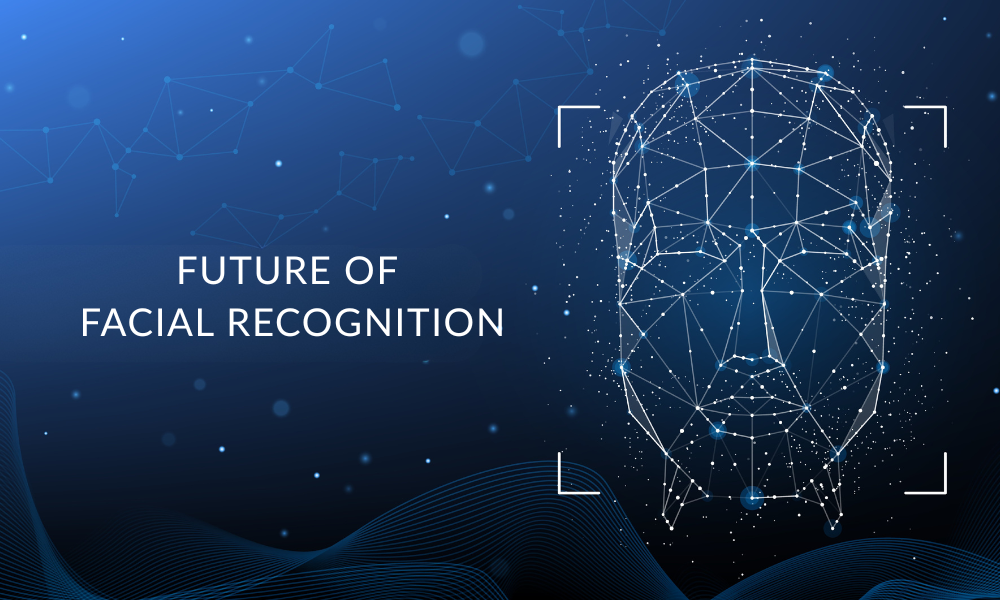
An individual’s face is scanned first, then compared with the face stored in the database. For every face, there is a particular mathematical code called a “faceprint.” Top advancements in machine learning algorithms, computing power, and next-gen image processing capabilities are the key pillars to the emergence and rapid growth of biometric facial recognition.
The Solid Opportunities that Come with Facial Recognition
Let’s take a look at the key opportunities that facial recognition offers across different sectors.
1. User Authentication
Often used to unlock phones, tablets, or electronic gadgets. This serves as an authentication mechanism to prevent unauthorized access.
2. Corporate Offices
Facial recognition can be widely used to enter into the workplace. It is also used to track employee attendance and timing, reducing the burden of manual tracking.
3. Construction
In the construction sector, it helps to restrict access on-site.
4. Online Banking
With the help of FTR technology banks into online banking, banks can reduce the risks of online passwords being leaked or stolen.
5. Healthcare
When integrated into hospital security video surveillance, facial recognition can make patient check-in easy, reducing manual work or avoiding human error.
6. Government and Law Enforcement
Facial Recognition is used in Government and Law Enforcement to increase the safety of the general Public by identifying suspects, controlling borders, and investigating crimes; however, it also raises some serious ethical and legal accountability matters.
Challenges in Facial Recognition
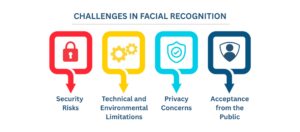
There are several challenges that arise in facial recognition technology. Here we have mentioned a few:
1. Security Risks
Even though facial recognition offers a high level of security, it comes with a range of security risks. Bad actors can use different malicious techniques such as deepfakes, insider threats, bio metric data breaches, and spoofing attacks wherein attackers can mask high-resolution images to impersonate real users.
2. Technical and Environmental Limitations
Facial recognition lacks delivering results in certain environmental and technical conditions. This includes low light, glasses, and changes in angles, which can also confuse the system. It stands as one of the biggest challenges in FRT, as you cannot simply rely on technology for access, identification, and more.
3. Privacy Concerns
Facial recognition can keep track of individuals without their consent or approval. For example, government organizations can implement facial recognition in public places such as airports, streets, and malls.
People are captured and identified without them knowing. Another example is of a shopping store that uses facial recognition to track repeat visitors and understand their behavior without their consent. This creates privacy concerns and causes risk to personal freedom, as it exposes one to being exposed.
4. Acceptance from the Public
Technology continues to grow if there is acceptance from the public. Even though a lot of people may be okay with the use of facial recognition for identification, others may have concerns regarding where their data would be stored, shared, etc. In short, it creates privacy concerns among the public.
Towards the Future of Facial Recognition Technology
The future of facial recognition is extremely promising. All sectors are widely adopting this technology, ranging from our homes and schools to private sector and government organizations. It is evolving every day, making biometric security seamless and accessible across every facet.
Nevertheless, the major good sides and growth come with concerns that need to be addressed. By implementing the best ethical practices and adhering to security guidelines, you can unleash the full potential of facial recognition technology. In the coming days, FRT will be adopted by banks and retailers soon.
To stay updated with more such blogs, visit us now!
Frequently Asked Questions
1. Is facial recognition safe?
Ans: In today’s evolving cyberthreat landscape, facial recognition is a safe biometric due to its uniqueness. It restricts unauthorized access. However, on the other hand, data security and privacy concerns arise.
2. What is AI face recognition?
Ans: AI face recognition, as the name suggests, uses Artificial Intelligence technology to identify or verify a person’s identity by scanning their face, images, or videos.
You Might Like: Computer Vision And Facial Recognition: Real World Applications