
ExtraMile by KnowledgeNile is a highly acclaimed interview series where the brightest minds in tech share real insights, success stories, and strategies powering the next wave of innovation! Our prime goal is to empower the audience with real-world wisdom from trailblazing leaders.
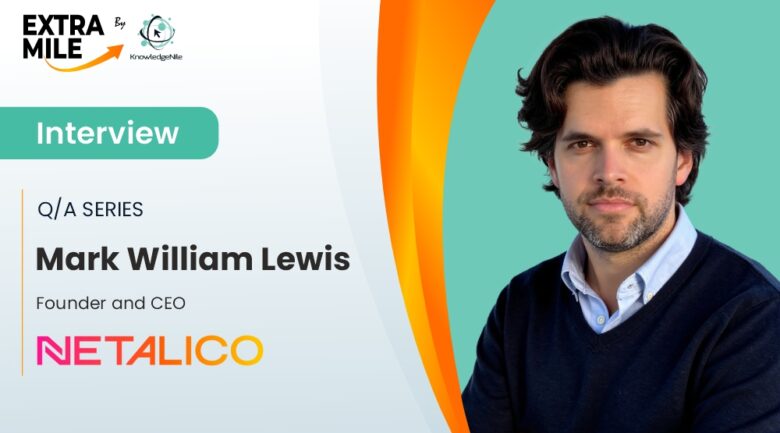
For this session, we are joined by Mark William Lewis, Founder and CEO of Netalico, a full-service eCommerce agency and Shopify Premier Partner. The firm has helped over 50 enterprise brands navigate through complex eCommerce platform migrations and optimization programs.
Our guest, Mark, brings 20 years of development experience and deep clarity to the world of Shopify Plus, SaaS, and eCommerce. He leads Netalico with a strong focus on engineering rigor, conversion optimization, and the emerging space of agentic commerce!
In this discussion, Mark shares his professional journey and dives deep into topics such as gaps in the Shopify ecosystem and conversion-optimization strategies. He also talks about Shopify Plus, the headless commerce reality check, agentic commerce, and, most importantly, how brands can prepare their product data for AI-driven discovery.
Indeed, this conversation is packed with valuable takeaways - let’s dive in!
Welcome to the session, Mark! It’s a pleasure to have you with us today!
How does your experience across organizations like Principled Technologies and NASA shape your objectives?
Mark. Working at Principled Technologies taught me the discipline of benchmarking and measurement. Everything we did had to be provable and reproducible, and that mindset stuck with me. When I moved to NASA as a Senior Technology Consultant, the stakes were different but the lesson was the same: build systems that are reliable, well-documented, and designed to perform under pressure. You learn quickly that cutting corners has real consequences.
Those experiences shaped how I built Netalico. We treat every eCommerce platform decision as something that needs to hold up under scrutiny, not just look good in a demo. When a brand is doing $20 million in annual revenue through their site, a sloppy migration or an untested checkout flow is not just an inconvenience. It is a material business risk. The engineering rigor I developed at those organizations is now the foundation of how we approach every client engagement, and it is a big part of why our client relationships tend to last years rather than months.
What is the first thing you look for on a homepage that most high-growth brands are still missing?
Mark. Clarity of value proposition above the fold. Most high-growth brands invest heavily in beautiful photography and polished design, but when you land on the page, you cannot answer the most basic question within three seconds: why should I buy from you instead of someone else? They lead with lifestyle imagery or a clever tagline that sounds good in a brand workshop but communicates nothing to a first-time visitor.
The homepage is the bottom of your marketing funnel. By the time someone arrives, they have already seen an ad or clicked a link. The job of the homepage is not to be impressive. It is to resolve doubt and move people toward a purchase decision. The brands that convert well are the ones that treat their hero section like a sales conversation, not a billboard. They state what they sell, who it is for, and why it matters, all in plain language. That sounds simple, but the majority of sites we audit are still getting it wrong.
What specific functionality is Shopify ignoring in favor of AI that is actually more critical for merchant success?
Mark. Native B2B functionality. Shopify has made massive strides with AI features like Sidekick and Magic, and those are genuinely useful. But the B2B capabilities on Shopify Plus are still playing catch-up to what merchants actually need. Wholesale pricing rules, customer-specific catalogs, quote workflows, net payment terms, and complex multi-location inventory management are all areas where merchants are still stitching together apps and workarounds to get basic functionality.
A huge portion of commerce is B2B, and many of the DTC brands on Shopify Plus also sell wholesale. Right now, they are either running a second platform for that channel or forcing a B2B workflow into a system designed for consumer checkout. If Shopify invested in making B2B a first-class experience within the platform, with the same level of polish they bring to consumer-facing features, it would unlock a massive segment of merchants who are currently stuck between platforms.
What is the one operational non-negotiable at Netalico that prevents burnout?
Mark. Rigorous time tracking tied to capacity planning. Every hour on every client account is tracked, not as a surveillance tool, but as a management tool. We use Harvest integrated with Asana, and that data feeds into weekly reviews where we look at utilization rates, project burn, and whether anyone on the team is trending toward overload. If the numbers show someone is consistently above a healthy threshold, we redistribute before it becomes a problem.
The reason this works is that it removes the guesswork and the guilt. In most agencies, burnout is invisible until someone quits. People absorb scope creep and weekend work because they do not want to raise a flag. When you have objective data showing that a client is consuming more hours than the retainer supports, you can have a straightforward conversation about scope, or you can staff up. It also means we make hiring decisions based on real data rather than gut feeling. That operational discipline is what lets a small team handle enterprise-level complexity without grinding people down.
What is the most common vanity reason brands go headless, and when does it become a financial mistake?
Mark. The most common vanity reason is speed. Brands hear that headless will give them a faster storefront, and their agency is happy to sell them on that narrative because it is a much larger engagement. The reality is that Shopify’s Liquid-based themes, especially with the 2.0 architecture, are already fast. The performance gains from going headless are often marginal, and they come at a steep ongoing cost.
The point of no return is when you have invested in a headless frontend without an internal engineering team to maintain it. That is where it becomes a financial mistake. With a standard Shopify theme, your team can make content changes, update product pages, and launch promotions without touching code. With a headless build, every change that used to take five minutes in the Shopify admin now requires a developer. If you do not have engineers on staff, you are permanently dependent on an external agency for even minor updates, and your total cost of ownership skyrockets. I tell brands: unless you have at least two to three frontend engineers in-house and a genuine technical reason that Liquid cannot solve, headless is adding complexity without proportional value.
What key design elements should brands consider to increase conversion rates?
Mark. The biggest lever is messaging hierarchy. Your site needs to guide someone from awareness to confidence to action, and every section of the page should serve one of those jobs. Above the fold, state what you sell, who it is for, and what makes you different. Below that, provide proof: reviews, press mentions, certifications, or before-and-after results. Then make the path to purchase effortless with clear calls to action and minimal friction in the cart and checkout.
Beyond messaging, the design elements that consistently move the needle are social proof placed near the buy button (not buried in a separate reviews tab), sticky add-to-cart on mobile, cross-sell recommendations on the cart page, and a clear returns or guarantee policy visible before checkout. Brands often overthink the visual design when the real issue is informational. If a customer cannot find the answer to their objection, whether that is shipping time, ingredient sourcing, or sizing, they leave. The best-converting sites anticipate those questions and answer them inline, right where the shopper is making the decision.
Walk us through a case where you deliberately lowered a client’s CR but increased their bottom-line profit.
Mark. We had a client in the health and wellness space that was running aggressive site-wide discounts and free shipping on every order. Their conversion rate looked fantastic on paper. But when we dug into the unit economics, the margins were razor-thin, return rates were high, and customer lifetime value was low because the discount-driven buyers were one-and-done shoppers chasing deals.
We restructured their offer. We removed the blanket discount, introduced a free shipping threshold that increased average order value, and shifted the messaging to emphasize product quality and results rather than price. Conversion rate dropped, because the bargain hunters left. But average order value went up significantly, return rates fell, and the customers who did convert came back at a much higher rate. Within a few months, total profit was meaningfully higher despite the lower conversion rate. That is why I push back on the industry’s obsession with CR as a headline metric. Conversion rate tells you how many people bought, but it says nothing about whether those purchases were actually profitable. Revenue per session and customer lifetime value are far better indicators of whether your site is doing its job.
What steps should firms initiate with their product data right now to be discoverable by AI agents?
Mark. The first thing is structured data. AI agents do not browse your site the way a human does. They parse structured information, so your product feeds need to be rich, accurate, and consistent. That means detailed product descriptions written in natural language (not just marketing copy), complete attribute data like materials, dimensions, compatibility, and use cases, and clean taxonomy so that every product is correctly categorized. If your product data is messy or incomplete, you are invisible to these systems.
Second, implement and maintain robust schema markup across your entire catalog. Google’s structured data, Open Graph tags, and JSON-LD are the languages that AI agents speak. Third, make sure your product content answers questions, not just describes features. When a consumer asks an AI agent to recommend the best running shoe for flat feet under $150, the agent is going to surface the product whose data best matches that query. The brands that treat their product content as a dataset rather than a brochure are the ones that will win in an agentic commerce landscape. This is a 2026 priority because the infrastructure, from Shopify’s ChatGPT integration to Google’s AI Overviews, is already live. Waiting until 2027 means playing catch-up against competitors who are already optimized.
Tune Into Our Other Informative Interviews: