

Imagine a world where the most powerful computer could fit on the tip of your pen, where doctors could find a single sick cell in your body, and where your phone battery could last for months. This isn’t science fiction. It is the promise of nanoelectronics.
This blog is your friendly guide to the fascinating world of Types of Nanoelectronic Devices. We will break down what they are, how they actually work in simple terms, and why they are the secret engines behind the technology of tomorrow. Let’s shrink down and explore!
What Does Nanoelectronics Mean?
Nanoelectronics is all about building electronic parts so small that you could fit thousands of them across the width of a single human hair. We are talking about working with materials and structures at the “nanoscale”, that’s one-billionth of a meter. At this incredibly tiny size, ordinary materials start behaving in extraordinary ways.
Why Go So Small? The Big Benefits of Thinking Tiny
Before we jump into the different Types of Nanoelectronic Devices, let’s understand why scientists are so obsessed with making things nano-sized.
First, it is about power and speed. Smaller devices mean electrons have less distance to travel. This allows for faster processing speeds and much lower power consumption. Your laptop gets quicker and your smartwatch battery lasts longer.
Second, it allows for massive integration. We can pack billions, even trillions, of these tiny devices onto a single chip. This is what has allowed our smartphones to become more powerful than the computers that sent astronauts to the moon.
Finally, at the nanoscale, quantum effects kick in. This means particles like electrons behave less like tiny balls and more like waves. This strange and wonderful behavior lets us create entirely new kinds of devices that are impossible to make with bigger parts.
Key Types of Nanoelectronic Devices
Now, let’s meet the main players. The Types of Nanoelectronic Devices are diverse, but they often build upon or revolutionize the classic components we know. Here are the most important ones.
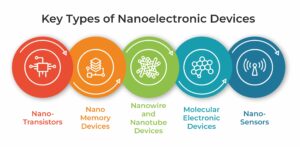
1. Nano-Transistors: The Ultimate Tiny Switches
The transistor is the fundamental on/off switch of all modern electronics. A nano-transistor is just its incredibly miniaturized version, often made from novel materials.
How They Work: Think of a nanoscale water gate. You have a source (where electrons come from) and a drain (where they go). Between them is a channel. A third part, called the gate, acts like the gatekeeper. When a small voltage is applied to this gate, it either opens the channel, allowing electrons to flow (ON state, meaning ‘1’), or closes it, stopping the flow (OFF state, meaning ‘0’). This basic switch is the foundation of all computing logic.
The Nano Twist: Instead of silicon, these might use materials like graphene (a single layer of carbon atoms) or carbon nanotubes (rolled-up sheets of graphene). These materials conduct electricity far better than silicon, promising even faster and more efficient switches. Companies like IBM and Intel are actively researching these to keep Moore’s Law alive.
2. Nano Memory Devices: Storing Data in a Speck
As we generate more data, we need denser, faster, and more durable ways to store it. Nano memory devices are the answer.
How They Work: Traditional memory stores data as electric charge. Nano memory often uses different physical principles.
Resistive RAM (RRAM): A tiny voltage changes the resistance of a special material sandwiched between electrodes. A high-resistance state is a ‘0’, and a low-resistance state is a ‘1’. It’s like permanently flipping a switch’s difficulty level.
Phase-Change Memory (PCM): Uses a material (like an alloy of germanium) that can switch between a messy, non-crystalline (amorphous) state and an orderly, crystalline state. The amorphous state has high resistance (‘0’), and the crystalline state has low resistance (‘1’). It’s like the difference between shuffled cards and a neatly stacked deck.
Why They are Better: These Types of Nanoelectronic Devices for memory are non-volatile (they keep data without power), are super fast, and can be stacked in 3D, creating huge storage in a tiny footprint.
3. Nanowire and Nanotube Devices: The Superhighways
Imagine wires so perfect and thin that electrons zip through them without bumping into anything. That’s the idea behind nanowires and nanotubes.
How They Work: Nanowires are solid rods, and carbon nanotubes are hollow cylinders, both only a few nanometers in diameter. They can be used as the channel in a transistor, as interconnects (the tiny wires linking transistors), or as super-sensitive sensors. Because of their perfect structure, they offer stunning electrical properties.
Real-World Example: Some of the newest and most sensitive gas sensors use networks of nanowires. When a gas molecule sticks to a nanowire, it changes its resistance noticeably, detecting even a single molecule of a harmful substance.
4. Molecular Electronic Devices: When a Single Molecule is the Circuit
This is where it gets mind-blowing. Here, individual molecules act as wires, switches, or diodes.
How They Work: Scientists design special organic molecules that can transport electrons. These molecules are placed between two microscopic metal electrodes. By changing the shape or energy state of the molecule (often with light or electricity), we can make it conduct or block current. It is the ultimate miniaturization, the device is the molecule.
The Future: While largely in labs, this research could lead to computers built from the ground up using chemistry, potentially revolutionizing how we design hardware.
5. Nano-Sensors: The Ultra-Sensitive Detectives
This is one of the most impactful Types of Nanoelectronic Devices. By being so small, they have a huge surface area relative to their size, making them incredibly sensitive to changes in their environment.
How They Work: A nanosensor might have a nanowire or a graphene sheet as its core. When a target, like a virus particle, a glucose molecule, or a pollutant, binds to its specially coated surface, it changes the device’s electrical property (like its resistance or capacitance). This change is measured as a signal.
Recent & Relevant Example: Research during the COVID-19 pandemic accelerated the development of nano-biosensors that could potentially detect viral proteins with incredible speed and accuracy from a simple breath or saliva sample, aiming for faster diagnosis.
Comparison between Traditional vs Nano
Feature |
Traditional Microelectronic device |
Nanoelectronic Device |
| Scale | Micrometers (µm) | Nanometers (nm) - 1000x smaller |
| Core Material | Primarily section | Graphene, Carbon Nanotubes, Molecules, etc |
| Primary Challenge | Miniaturization limits, heat | Controlling quantum effects, manufacturing precisions |
| Key Advantages | Mature, mass-produced technology | Revolutionary speed, efficiency, and new functionalities |
The Challenges on the Tiny Road
Building these devices is not easy. It is like trying to assemble a watch with tweezers under a microscope, but even harder.
-
- Manufacturing: Creating billions of identical nanoscale structures cheaply is hugely complex.
- Heat Dissipation: Packing devices so closely generates a lot of heat in a tiny area.
- Quantum Tunneling: Electrons can “tunnel” through barriers meant to block them, causing leaks and errors.
- Consistency: At the atomic level, even a single atom out of place can change a device’s property.
The Future is Nano
The journey into the nanoworld is just beginning. The different Types of Nanoelectronic Devices we explored are paving the way for:
Quantum Computers: Using the quantum states of particles (like “superposition”) to perform calculations impossible for today’s computers.
Medical Nanorobots: Tiny devices that could deliver drugs directly to cancer cells or clean up plaque from arteries.
Ultra-Efficient Energy Harvesters: Nanogenerators that could power your devices from your body’s movement or ambient room light.
Final Words!
In conclusion, the world of Types of Nanoelectronic Devices is not just about making things smaller. It is about unlocking a new set of rules, including quantum physics, to build a smarter, healthier, and more connected world. They are the quiet, tiny giants upon which our future will be built, one atom at a time.
So, the next time you use your phone or a medical device, remember, the magic inside is getting smaller, smarter, and more powerful every single day.
To learn more, visit KnowledgeNile!
FAQs
1. What are nanoelectronic device?
Answer: Nanoelectronic devices are tiny electronic components built using nanotechnology.
2. What are the four types of nanomaterials?
Answer: carbon-based materials, metal-based materials, dendrimers, and composites are the four types of nanomaterials.
Recommended For You: