
Zigbee is an IEEE 802.15.4, open, and global wireless communication protocol primarily designed for low-power, low-bandwidth Wireless Personal Area Networks (WPANs). Zigbee is a reliable, interoperable connectivity option for a range of IoT applications, including smart home automation, HVAC control, wireless sensor networks, and more.
The Zigbee protocol stack is a structured, multi-layer communication framework that is reliable, secure, and offers efficient data transmission across IoT applications. It's a four-layer architecture with three sub-layers.
Wherein the IEEE 802.15.4 defines the Physical (PHY) and Medium Access Control (MAC) layer, and then the higher layers of network, security, and application layer. This blog explains the Zigbee protocol stack and its functionalities to help you better understand and build the next high-performing IoT solution.
What is the Zigbee Protocol Stack?
The Zigbee protocol stack is a layered architecture composed of a series of protocol blocks, or layers. Each layer provides a specific service to the layer above. It defines how data is transmitted, routed, secured, and shared across Zigbee-enabled devices.
The Zigbee protocol works on the OSI (Open Systems Interconnection) and high-level layers defined by the Connectivity Standard Alliance. The following layers are present in the Zigbee Protocol Stack:
- Physical Layer PHY
- Media Access Layer (MAC)
- Network & Security Layer
- Application Layer
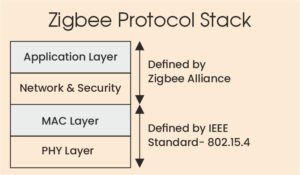
The MAC and PHY layers of the protocol are built on IEEE 802.15.4 standards. Let us understand the Zigbee architecture in detail.
1. Physical Layer
The Physical layer is the main and lowest layer that manages the transmission and reception of raw data over the wireless medium. It is based on the IEEE 802.15.4 standard and operates in the 2.4 GHz in the 2.4 GHz ISM band globally, alongside the 915 MHz (North America) and 868 MHz (Europe) bands.
Core functionalities:
- Can manage data rates (up to 250 Kbps)
- Handles modulation and demodulation, and error detection
2. Medium Access Layer (MAC)
The MAC layer lies between the physical layer and the network layer. This layer ensures that different Zigbee devices can communicate efficiently without data collisions. The MAC structure is comprised of three fields: MAC payload, MAC header, and MFR (FCS). It helps to manage channel access and utilize mechanisms such as CSMA/CA.
Core Functionalities:
- Frame validation and acknowledgement
- Association and disassociation of devices
- Manages network PAN ID
- Offers a basic level of security using encryption and integrity checks
3. Network and Security Layer
A] Network layer:
It lies between the MAC layer and the application layer. It works well for routing, maintenance, and network formation. Alongside this, it can efficiently handle mesh networking and routing, and more, within the Zigbee network. The two service entities it provides are NLDE (data service entity) and NLME (management service entity).
Core functionalities:
- Establishing the PAN network
- The network layer can control the reception time and server status.
- It can route data packets with ease
- Address assignment (16-bit addresses)
B] Security layer:
In this, Zigbee security spans multiple layers to ensure data encryption, integrity, and authentication. When security is enabled, the Zigbee device will begin using a 128-bit AES encryption key and can communicate securely within the PAN only if they share a similar security key.
Core functionalities:
- Efficiently handles the creation, distribution, and storage of cryptographic keys
- Keeps data secure from unauthorized user access
- Makes sure that trusted devices can easily join and communicate in the network
4. Application Layer
The Application layer stays at the top of the Zigbee protocol stack. For interpretability, it mostly consists of application profiles that show the typical behavior of Zigbee devices. The Zigbee application layer comprises three components.
A] Application Support Sub-layer
The sublayer ensures communication between the application and network layer. It handles end-to-end security and helps manage data encapsulation, frame formatting, and more in manufacturing applications.
Core functionalities:
- Manages data formatting and binding between devices
- Keeps device secure
B] Zigbee Device Objects (ZDO)
ZDO allows coordination between the application layer and the application support sublayer by providing a management and control interface for Zigbee devices. The endpoints of the application layer can get information about the network or other nodes through ZDO.
Core functionalities:
- Outlines the roles and services of devices.
- Manages joining and finding networks.
C] Application Framework
The structure of Zigbee applications and communication between applications objects on a device are given by the Application Framework. By arranging data models, application profiles, and endpoints, it stands as standardized communication between devices.
Core functionalities:
- Offers framework for creating and managing application endpoints
- Supports binding and communication between application objects
Zigbee Network Topologies
Zigbee supports different network topologies, including:
- Star: Here, all Zigbee end devices communicate through a central coordinator.
- Mesh: Allows Zigbee devices to communicate with each other through different nodes. It's the most used topology for smart homes.
- Tree: Follows a hierarchical structure where the data flows according to parent-child relationships.
Advantages of Zigbee
- Zigbee is meant for low-powered consumption.
- Used widely in smart home applications.
- Zigbee supports thousands of devices, making it best for large-scale projects such as industrial automation, smart cities, and more.
- Zigbee models are cost-effective, and the protocol requires less infrastructure, reducing total deployment and maintenance costs.
- Zigbee protocol uses a mesh networking topology, allowing devices to communicate with each other.
Final Words!
Finally, the Zigbee Protocol stack offers a low-power, reliable, and scalable communication framework for IoT applications. Its robust architecture ensures guaranteed security, data transfer, and interoperability. We now have a clear understanding of all the Zigbee layers; businesses and developers can start designing, optimizing, and implementing IoT solutions with the Zigbee technology.
Visit our blog section to stay in the know of the latest tech topics.
FAQs
1. Which are the four layers of Zigbee?
Answer: The Zigbee network consists of four layers, including the Network layer, Application Layer, Physical Layer, and Data Link Layer.
2. Zigbee is based on which protocol?
Answer: Zigbee is based on IEEE 802.15.4, which is the base protocol. It depicts the low-rate personal area networks (LR-PAN).
3. Is ZigBee TCP or UDP?
Answer: ZigBee is neither TCP, nor UDP; it’s a low-power mesh networking protocol which works on IEE 802.15.4 standards.
Also Read:
Zigbee On The Internet Of Things: Advantages And Disadvantages