Artificial intelligence is changing the way we do business, process data, make decisions, and so much more. The possibilities of what AI can do are limitless. Notably, the golden age of classical or traditional computing has passed, as it has become increasingly inefficient at handling the complexity of AI.
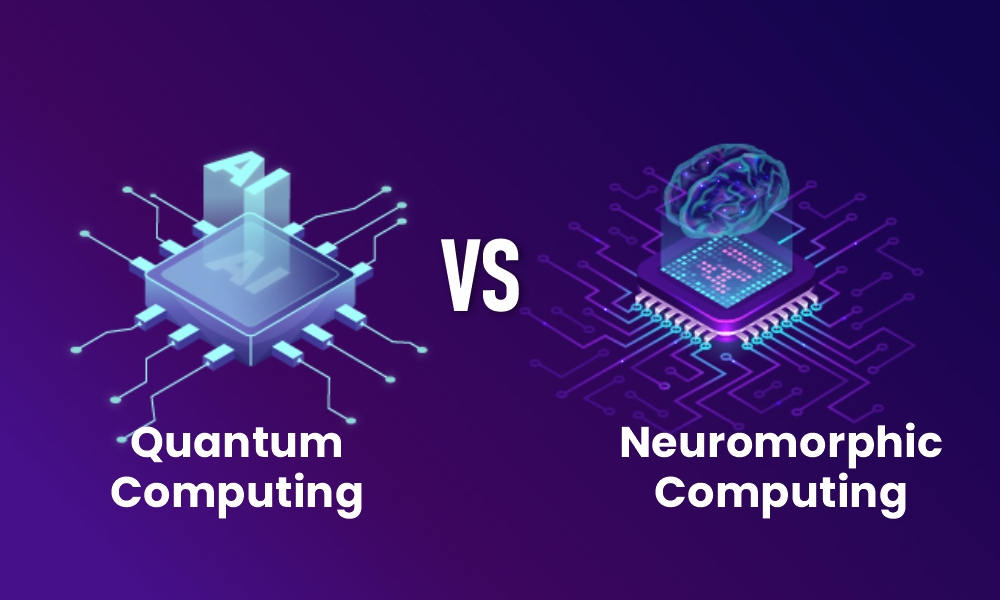
In short, the computing scenario is gradually transforming into a bigger picture! Two potential gamechangers have merged into the world of computing, namely quantum computing and neuromorphic computing.
Both of these technologies have their own unique qualities and are here to refine AI performance. But the question is, which will shape the future of AI? This blog discusses the key differences between quantum computing and neuromorphic computing, along with detailed information on their benefits and use cases, to help you better understand the world of computing.
What is Quantum Computing?
Quantum computing is a form of computing that uses quantum mechanics to process information, which relies on qubits instead of classical bits. Classical computers that use bits, which are 0 or 1, Quantum computers use qubits that can be in both states at the same time through superposition and can be linked through entanglement.
They are ideal for solving complex or significant problems that would take years for traditional/classical computers to solve. Quantum computing deals with the world of atoms and subatomic particles.
Advantages of Quantum Computing
- High-Speed: Can solve complex problems at an unprecedented speed.
- Solve the Complex: Quantum computers can solve the most challenging optimization problems that are difficult to solve with traditional computing.
- Revolutionary AI/ML: Can process vast amounts of data for machine learning.
Use Cases:
- Drug discovery and development
- Financial modelling
- Weather forecasting
- Material science and design
- Cybersecurity
What is Neuromorphic Computing?
Neuromorphic computing is a computing approach that mimics the human brain. It requires designing hardware and software that mimics biological neurons and synapses. It exchanges information only via spikes, allowing parallel and event-driven processing.
This design enables neuromorphic systems to perform tasks such as perception, learning, and pattern recognition with extremely low power consumption and minimal latency.
Key Principles of Neuromorphic Computing
- Event-driven processing
- Massive parallelism
- Low power consumption
- On-device learning and adaptation
Benefits of Neuromorphic Computing
- Highly energy-efficient compared to traditional GPUs or CPUs.
- They are capable of processing messy or natural data just like our brain does with sound and sight.
- Learn and adapt to data quickly without retraining.
- Can process information immediately as the event takes place, reducing the delays, which is ideal in robotics.
Use Cases
- Robotics
- Fraud Detection
- Image and video recognition
Head-to-Head Comparison: Quantum vs Neuromorphic Computing
| Parameter | Quantum Computing | Neuromorphic Computing |
| Principle | Quantum mechanics | Brain, Human inspired |
| Strength | Heavy computational power | Highly energy-efficient |
| Power consumption | Extremely high (requires crypto cooling) | Extremely low (in milliwatts) |
| Use cases | Optimization, simulations | Edge AI |
| Challenge | Qbit stability | Developing algorithms and software |
Which Will Shape the Future of AI?
The future of AI will be determined not by a single technology but with the interrelation of quantum and neuromorphic computing. Quantum computers promise significant advancements in training complex models, scientific exploration, and other time-consuming optimization tasks in artificial intelligence.
Neuromorphic computing will enable intelligent systems that interact with the physical world, for example, robots, self-driving cars, smart cities, and wearables.
In terms of near-term influence on artificial intelligence, neuromorphic computing is more likely to influence the deployment side of artificial intelligence. Quantum computing is likely to have a longer-term influence on artificial intelligence, related to training.
Concluding Remarks!
It’s clear that this isn’t just a race to replace silicon, instead of a rise in the multi-modal computing ecosystem. Neuromorphic computing is here to push AI beyond the cloud and into everyday environments, enabling autonomous systems that interact effectively in the real world.
On the other hand, quantum computing remains in the cloud powerhouse with specific use cases in science, medicine, and more. With that being said, it is essential to understand the key differences to help you understand better.
Visit our website to check out more trending tech topics.
Frequently Asked Questions
Q1. Can neuromorphic chips run ChatGPT?
Ans: No, neuromorphic chips are optimized for spiking networks, and not for LLMs as of now.
Q2. Is neuromorphic computing the future of AI?
Ans: Absolutely! Neuromorphic computing is the new generation of AI. It is faster, smaller, and more efficient than the human brain.
Recommended For You:
Impact of Quantum Computing: A New Age Technology
Quantum Internet and The Future of Ultra-Secure Communication