
Attaining business growth without impactful marketing is quite challenging. Hence, we have seen the use of marketing in different ways over the years, whether in digital or traditional marketing. Guerrilla marketing is one such strategy that has been a long-standing companion to brands around the world.
We often see out-of-the-box marketing endeavors attract more people than conventional methods. Guerrilla marketing is among the strategies that go beyond conventional marketing, with positive results for marketers. Data reflects that over 90% of consumers consider such marketing initiatives memorable, 30% higher in comparison with orthodox marketing strategies.
Additionally, marketers believe that guerrilla marketing drives word-of-mouth five times higher than traditional marketing, solidifying the success rate of a brand’s overall marketing efforts.
Let us explore guerrilla marketing examples to understand this strategy thoroughly, alongside discussing its benefits...
What is Guerrilla Marketing?
Guerrilla marketing is an unconventional approach that uses surprise, creativity, and low budgets to capture attention. It focuses on memorable moments in public spaces and on social media rather than large paid media buys. The aim is to spark conversation and get people to share the idea. This style grew from the idea that clever execution can beat big budgets when it comes to brand recall.
Historically, the term guerrilla marketing was coined by Jay Conrad Levinson in 1984, in his book with the same title. Levinson was an American Business author and explained this particular marketing strategy as a low-cost and high-impact tactic that can be highly advantageous for small businesses and startups.
At its core, guerrilla marketing follows the methods of guerrilla warfare, a military strategy that involves small-group-led ambushes and raids against a larger, more conventional army. Surprisingly, guerrilla warfare became highly advantageous for small troops when it came to distracting and creating trouble for their enemies. Keeping this intent in mind, marketers adopted guerrilla marketing as an unconventional yet highly effective approach.
One of the best guerrilla marketing examples is the outdoor street advertising campaign by McDonald’s. It not only attracted consumers of all ages but also became memorable for pedestrians.
Contemporarily, guerrilla initiatives have gained enhanced impact alongside AI and other technological integrations.
How Can Guerrilla Marketing Be Beneficial for Your Business?
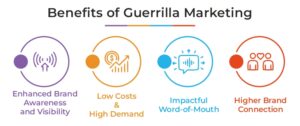
Enhanced Brand Awareness and Visibility:
Guerrilla marketing generally includes unconventional ways to surprise and attract an audience. It helps boost brand awareness and visibility in the market.
Low Costs and High Demand:
Guerrilla tactics seek small budgets. A single clever initiative can reach thousands with little media-spend. This makes guerrilla marketing attractive for startups and small businesses.
Impactful Word-of-Mouth:
It also drives word-of-mouth. When people find something unexpected or delightful, they talk about it. That conversation often moves online fast, turning local efforts into broader awareness.
Higher brand connection:
Guerrilla marketing can deepen brand connection. Well-designed activations create emotional responses. Those moments make brands feel more human and memorable. Finally, it enables teams to think like storytellers. You learn to deliver clear ideas that people can retell while recalling your brand.
5 Success Stories: Guerrilla Marketing Examples
McDonald’s MacFries Pedestrian Crossing:
McDonald’s has been a marketing genius for years. One of the finest guerrilla marketing examples includes McDonald’s MacFries pedestrian crossing campaign. It adopted outdoor marketing accompanied by memorable street art. The campaign combined marketing with creativity to attract the attention of the pedestrians.
As a result, audiences saw the MacFries at a zebra crossing and were quickly inspired to grab a Happy Meal from the nearest McDonald’s.
Outcomes:
-
- Increased brand visibility
- Social media buzz
- Emotional connection with the audience
- Enhanced sales
UNICEF’s Dirty Water Vending Machine Campaign:
UNICEF adopted an unconventional way to spread awareness about the sustainability concerns related to packaged water bottles. The non-profit organization installed vending machines for bottles filled with dirty water, highlighting the bottled water consumption and its threat to sustainability.
The campaign came with a question: “What if those bottles of water you waste money on were filled with dirty water?” It targeted the audience with easy access to clean water yet spent on bottled water. While selling dirty bottled water in the vending machines, UNICEF tagged each button with a disease caused by dirty water.
Outcomes:
-
- Impactful communication
- Enhanced awareness
- Significant attention from the media
- Emotional connection with the audience
Google Pixel’s Fold Campaign:
Google adopted a larger-than-life approach while promoting its Pixel Fold mobile. The campaign included digital out-of-home campaigns of guerrilla marketing, which displayed 3D illusion billboards across big cities like New York and London. Google merged innovation with creativity.
The marketing approach grabbed the eyes of the audience, easily making Google’s product launch a successful one. Additionally, the campaign observed remarkable social media attention, leading to it being one of the impactful guerrilla marketing examples.
Outcomes:
-
- Significant exposure
- Impactful product demonstration
- Enhanced product and brand awareness
- Solid market positioning
Samsung’s Appel Giveaway Campaign:
Samsung adopted guerrilla marketing to gain a competitive edge and expand reach in Appel, a small Dutch village. Samsung assessed the broad Apple user base in the particular region and initiated a unique yet impactful marketing strategy. The firm gave away hundreds of Galaxy S9 phones for free in the village of Appel.
The strategy resulted in a fruitful way for Samsung, offering remarkable audience attention and expanding the brand’s user community. Additionally, the tactic offered a competitive advantage in a region where Apple dominated.
Outcomes:
-
- Competitive edge
- Remarkable social and media attention
- Increased product awareness
- Impactful word-of-mouth
Tesla’s Zero-Budget Campaign:
In 2018, Elon Musk’s Tesla pulled one of the most impactful marketing campaigns to date with just the mindset that later became the campaign name, $0 Ad budget. The firm made it to the headlines while adopting unconventional marketing initiatives on a no-budget. In 2018, Tesla promoted its electric sports car, Roadster, in space without investing anything. Indeed, a guerrilla initiative.
Sounds unreal? But Tesla did it in collaboration with Musk’s spaceflight firm, SpaceX. SpaceX launched the Falcon Heavy Rocket in 2018, which carried Roadster’s dummy, apparently the first car in space. The strategy drove ultimate marketing results, amazing people across the globe. The phenomenon was streamed live on various platforms.
Outcomes:
-
- Global attention
- No investments
- Faster word-of-mouth
- Higher sales
Concluding Remarks!
Guerrilla marketing is not a replacement for strategy. It works best when it supports clear goals, audience insight, and follow-up plans. Start with a single sharp idea that rewards participation. Measure the key performance indicators, like social mentions, website visits, and local foot traffic. Finally, be mindful of local rules and permissions.
A clever step of guerrilla marketing can backfire if it crosses legal or ethical lines. When done well, this marketing strategy gives smaller firms a way to cut through the noise with creativity, not just investment.
Though such marketing efforts were adopted significantly by small firms, they have gained the attention of bigger organizations over the last few decades. From retailers to tech and entertainment, every industry has been adopting guerrilla marketing for enhanced reach.
Visit KnowledgeNile and gain knowledge on diverse marketing strategies and technologies!
FAQs:
1. What are the four types of guerrilla marketing?
Answer: Outdoor or ambient marketing, indoor marketing, event or ambush marketing, and experiential marketing are the four major types of guerrilla marketing.
2. What is another name for guerrilla marketing?
Answer: Ambush marketing or buzz marketing resonates with guerrilla marketing.
3. Who is the father of guerrilla marketing?
Answer: Jay Conrad Levinson is the father of guerrilla marketing.
Recommended For You:
Pros and Cons of Guerrilla Marketing Explained
How does Personalized Website Experience Boost B2B Marketing?