
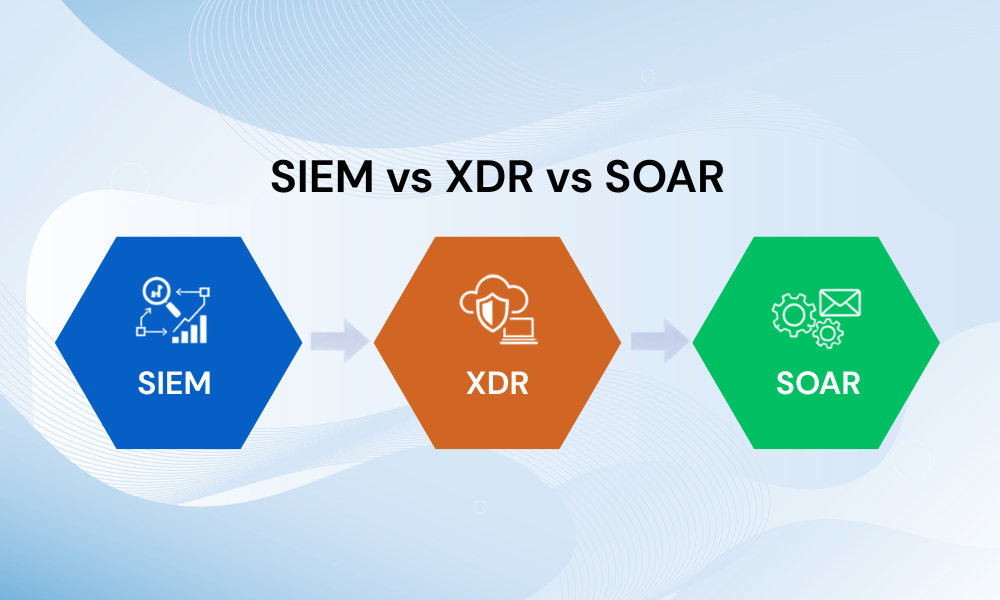
With the rise in cyberthreats, organizations are constantly looking for security tools to prevent potential breaches. There are different security operations tools available in the market; among these are SIEM, SOAR, and XDR, which are commonly used.
SIEM focuses on logs and compliance, XDR on threat detection, and SOAR on incident response automation. While these tools often overlap and integrate with one another, each one plays a significant role in improving an organization's overall cybersecurity posture.
Comparing SIEM vs XDR vs SOAR will help you better understand which security operation tool best suits your firm's needs. Keep reading the blog and know their key differences, along with their features, costs, use cases, and more to make a well-informed decision for your business. Let's get started.
What is SIEM?
SIEM (Security Information and Event Management) is a cybersecurity tool that collects logs and events across your environment, including endpoints, servers, firewalls, and more. It stands as the key to the foundation of most security operations, bringing these logs to a single platform to provide organizations with complete visibility into threats and incidents. Over time, SIEM has evolved to address compliance issues, including centralized log retention and monitoring that requires frameworks like SOC 2 (CC7.2), PCI DSS (Requirement 10), and ISO/IEC 27001, alongside threat detection capabilities.
Key Functionalities:
- Sustained retention for forensics and regulatory requirements.
- Collects all the log data into a centralized platform.
- Provides visibility into threats by using data across your environment.
- Makes use of data to produce alerts, incident responses, and more.
SIEM Pricing & Vendors to Know
Key Vendors: IBM QRadar, Splunk, and Microsoft Sentinel (cloud-native, Azure integration)
Pricing Model: Per-GB or per-EPS.
Cost: $150K-500K/yr for mid-size market.
What is XDR?
XDR (Extended Detection and Response) combines multiple security tools into a single platform to improve threat detection and response across environments. For example, it blocks or isolates compromised devices from your network. Unlike traditional approaches, it streamlines complete data ingestion, analysis, and prevention across the organization's security stack. In the case of XDR, organizations can achieve faster, more accurate threat detection and response through a single console.
Key Functionalities:
- Faster threat detection.
- Automated investigation that reduces manual workload.
- Deliver insights to security teams in a normalized format through a single console.
- Collect and analyze data from endpoints using automation and AI tools.
Vendors: Microsoft Defender XDR, and CrowdStrike Falcon (leader in endpoint-originated XDR)
Pricing Model: Per endpoint or per asset.
Cost: $50K-$100K per year.
What is SOAR?
SOAR (Software Orchestration, Automation, and Response) is basically a collection of software programs that aim to improve an organization’s overall security posture. It connects your security tools and runs playbooks that automate repetitive responses. Security teams can act faster without having to click through every threat alert manually. They can collect security data from different sources, such as threat intelligence platforms and security information and event management systems (SIEM).
Key Functionalities:
- Collect threat data and automate threat responses.
- Leverages manual and human intervention with machine learning technologies to analyze security data and prioritize incident responses accordingly.
- Automates workflows like ticketing, threat enrichment, deactivating a user account, and more.
SOAR Pricing & Top Vendors to Know
Vendors: Palo Alto XSOAR, Splunk SOAR, Tines (low-code, modern), and Microsoft Sentinel.
Pricing Model: Per action or flat tier.
Cost: $25K-$100K per year.
SIEM vs XDR vs SOAR: Side-by-Side Comparison
Even though all these tools aim to strengthen your security operations, here are some of the key differences you should know.
Parameter |
SIEM |
XDR |
SOAR |
| Full name | Security Information and Event Management | Extended Detection and Response | Security Orchestration Automation & Response |
| Key functionality | Collect and stores logs. | Detects and prevents attacks. | Helps to automate threat detection and response. |
| Who runs it | SOC teams. | IT team or security professionals. | SecOps teams. |
| Data sources | Firewalls, networks, endpoint applications, and cloud services. | Endpoints, emails, networks, and security tools. | Integrates with SIEM, XDR, EDR, and other security platforms. |
| Automation level | Low to moderate | Moderate to high | Very high |
| Strength | Meets visibility and compliance requirements. | Supports cross-layer correlation. | Delivers speed, and accuracy in automation. |
| Best Use Case | Organizations that need centralized monitoring, logging, and compliance. | Organizations looking for faster threat detection and response across multiple environments. | Organizations looking to automate repetitive security operations and enhance response times. |
How to Choose the Right Security Solution? SIEM, XDR, or SOAR?
Before making the right decision, SIEM vs XDR vs SOAR organizations or SOC teams must consider various factors, such as budget, threat complexity, infrastructure, and more. Closely analyzing each aspect will help you choose the right solution to enhance the organization's security posture.
Sr.No |
Choose SIEM If |
Choose XDR If |
Choose SOAR If |
| 1 | You need centralized compliance and log management. | You need enhanced threat detection and response. | Your team is looking to automate repetitive tasks. |
| 2 | You need compliance frameworks such as SOC 2, PCI DSS, or ISO 27001. | You need a single console instead of multiple tools. | You already have SIEM or XDR in place and want to automate the workflows between them. |
Does Your Business Need All Three Platforms?
Some organizations prefer using a triple security tech stack. They prefer XDR to monitor their network and endpoint devices, SOAR for automation, and SIEM for logs. The three stacks are great for organizations having a massive budget, complex IT infrastructure, and a dedicated 24/7 SOC team to run everything. Alongside:
- High Security Maturing: Well-defined security processes and experienced professionals to integrate and optimize security tools over time.
- Strong Integration and Maintenance Capabilities: Organizations that can tune, configure and maintain integrations between XDR, SIEM, and SOAR to reduce false positives and ensure a smooth workflow.
The Bottom Line on SIEM vs XDR vs SOAR
It is essential to understand the differences between XDR, SIEM, and SOAR to choose the right solution that aligns well with your organization's security needs. Hope the above blog has helped you understand the key differences and make the right choice. Considering the evolving threat landscape, the need for security tools is no longer an option, but a must-have. Choose the right tool to protect your organization from security threats.
Read all the informative blog posts around the tech, business, and marketing landscape on our website.
FAQs
1] Will XDR replace SIEM?
Answer: No, XDR and SIEM do not replace each other. However, relying on either alone leaves a major weak spot.
2] What are the three types of SIEM?
Answer: The three key types of Security Information and Event Management (SIEM) systems are on-premises, cloud-based, and hybrid.
3] Which tool should a small business start with?
Answer: Mostly if you are running a small business, it is a good option to start with SIEM for compliance industries, or XDR for faster threat detection. You can then add SOAR once the security operations scale and repetitive tasks start slowing down the team.
Recommended For You: