
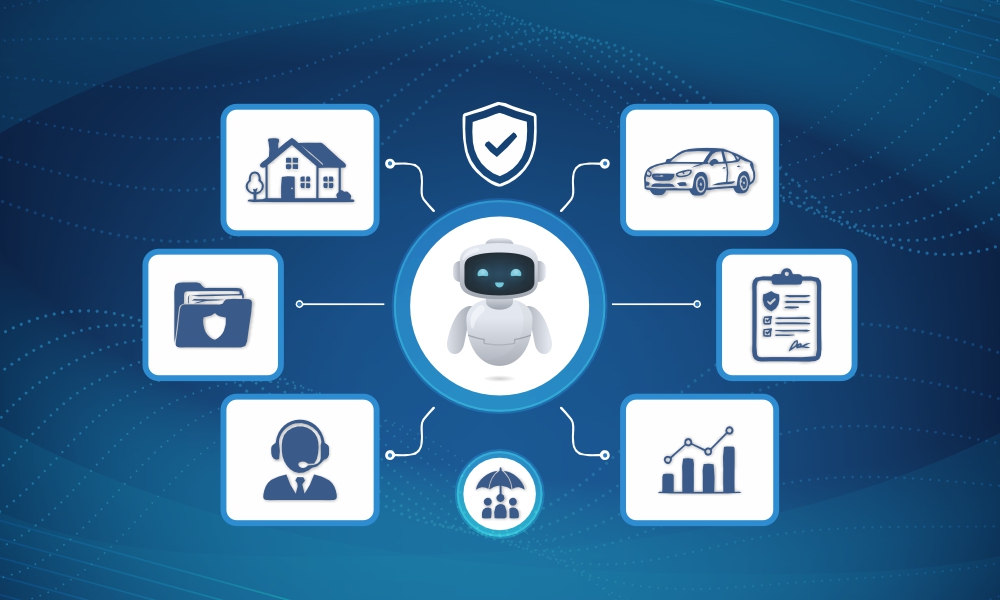
Artificial Intelligence (AI) is bringing huge change to all industries, including the insurance industry. Processes like assessing risks, resolving claims, and interacting with customers are all being automated by AI agents for insurance.
In 2024, the AI in the insurance industry was valued at $2.85 billion. By 2029, it is estimated to reach $11.92 billion with a Compound Annual Growth Rate (CAGR) of 33.1%.
Let us find out why insurance companies are integrating AI agents with their operations and the benefits and risks associated with the undertaking.
Understanding AI Agents for Insurance
In simple terms, AI agents are artificial intelligence structures that do not need human intervention to function. AI agents for insurance are task-based systems that leverage data and learning algorithms to perform insurance-related tasks without human interference.
Traditional automation follows a rule-based structure. AI agents learn from the provided information, actively interact with people and systems, and modify their operations based on the reports. They make use of Machine Learning (ML), Natural Language Processing (NLP), and process automation technologies.
Importance of AI in the Insurance Industry
The insurance industry is a busy industry. AI agents for insurance are digital assistants that aid insurance processes by reducing response times, increasing productivity, and consistently engaging with customers through automation.
In insurance, AI agents quickly gather policy details, identify necessary documentation, flag suspicious activities, and analyze coverage eligibilities.
These insurance AI agents are so advanced that they can also assess the tone and sentiments of policyholders and provide personalized responses according to their emotional states. They are also useful for routine inquiries and recurring queries. These tasks might get repetitive for human agents.
Building AI Agents for the Insurance Industry
How can you integrate AI agents with your insurance company? Follow the steps below:
- Define goals: First, set the objectives of your insurance business. This can include reducing operational costs or lowering claim processing times.
- Organize data: AI agents should be able to pull from accurate data. Organize data so that it is centralized and accessible to these agents.
- Choose relevant functions: Newcomers starting their business can opt for high-impact, low-risk functions to first gain confidence in the operations and then adopt them widely.
- Integrate appropriate technologies: Make use of AI platforms that align with insurance industry needs. Incorporate tools that have pre-built insurance facilities, can be integrated easily with existing systems, and include scalability options.
- Properly train these AI agents: Next, configure these AI agents using business rules and suitable data such as past policies, claims, and customer interactions.
- Optimize and increase scale: Expand the use of AI across the business after the initial implementation is successful.
Benefits of AI in Insurance Automation
- Claims resolution made faster: AI agents for insurance claims processing select and condense the important information from complicated medical files, policy documents, and claim records. This helps human agents make faster decisions and decreases the claim cycle times.
- Enhancement of policyholder retention: Customer service personnel can promptly access policy histories and relevant coverage information through AI agents. This ensures accurate and fast responses to servicing queries, improving policyholder loyalty.
- Simplification of insurance processes: AI agents connect workflows such as underwriting, issuing policies, and answering queries. This unifies previously isolated processes. They prioritize the submissions according to risk and urgency and also ensure the handoffs between teams happen without any hassles.
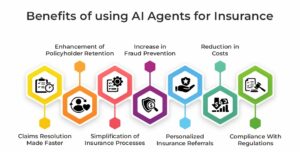
- Increase in fraud prevention: AI agents use algorithms that alert them to suspicious activities in real-time. This helps mitigate risks and minimize financial losses.
- Personalized insurance referrals: These agents can access data and claims history of customers, including life events and interaction patterns. Then the agents can provide personalized policy recommendations appropriate for each individual’s unique circumstances, bettering customer relations.
- Reduction in costs: Automating routine operations, minimizing fraud, and identifying scams before they can cause serious damage saves operational costs. AI-based virtual assistants can handle customer support, reducing the need for human teams to handle these inquiries. This also contributes to cost saving.
- Compliance with regulations: Agents ensure that the businesses are consistently following all legal guidelines and regulations throughout their workflows. It is easy to maintain transparent audit trails and track changes in regulations with AI agents. This helps businesses avoid fines and other disciplinary charges.
Risks and Challenges of AI in Insurance
- Data leaks: AI collects, stores, and analyzes all data on the internet. This creates data confidentiality issues when personal data can be accessed at a low cost without consent. It is understandable that some customers may be hesitant to use AI agents due to the lack of privacy guarantees.
- Security risks: Third parties can copy the model of the AI agent if the parameters of the algorithm are leaked. This can lead to intellectual property and economic loss for the creator of the model. Modification of AI algorithm parameters by cyber attackers can affect performance and lead to unfavorable outcomes.
- Can be inaccurate: Accurate data is essential for AI agents to perform their tasks efficiently. If the agent is trained with biased, incorrect, or plagiarized information, it will provide unsuitable results regardless of design.
- Overconfidence in AI agents: Unaware customers may not question faulty AI recommendations since they do not know the extent of AI’s capabilities. Similarly, a claims adjuster may not be able to consider multiple perspectives or handle new situations, as their knowledge may be limited to the cases only managed by AI.
AI Use Cases in the Insurance Industry
You will be glad to know that many insurance processes hold the potential for automation with the help of AI agents. These are just a few of them:
Optimized Claims Processing
Claims processing in insurance is time-sensitive by nature. If a major disaster like an earthquake occurs, hundreds of claims can arise within a short amount of time. Each claim must be verified in terms of validity and severity. Then it is allocated to an adjuster and pursued to resolution. This process is time-consuming if done manually.
AI agents streamline this process by automating important steps. They categorize the claims by estimating the damage using available data sources. Then they forward this information to the local adjuster when it suits the set criteria.
Timely Policy Renewals and Customer Engagement
Renewing policies is a part of maintaining relationships with customers. But there is no personalization in terms of the unique needs of each customer. This creates overlooked opportunities for coverage adjustments, making customers feel neglected.
AI agents can monitor each policy timeline, automatically assess usage trends, and policy updates to create customized proposals.
Refining Underwriting through AI Insights
Underwriting elaborate policies, such as life insurance, requires details from financial and medical records as well as input from external experts. All this data needs to be validated and cross-referenced before risk assessment can happen. These tasks can be slow and faulty if done manually.
AI agents are more efficient as they automate data retrieval from multiple sources across the web, detect inconsistencies, and flag odd data.
Enhancing Fraud Detection with AI Analysis
Insurance fraud is a notoriously common issue in the industry. Businesses have lost billions because of false or exaggerated claims. Uncovering fraud manually is a lengthy task due to the challenges of pinpointing discrepancies and subtle recurring patterns.
AI agents aid the process by consistently monitoring claim inputs and data, integrating inputs from different sources, and identifying atypical patterns.
In Conclusion
There are risks to all innovative technologies, including AI agents for insurance. Our personal data is out there to be accessed by AI agents, consensual or not. The outputs can be inaccurate and pose security risks. People may start over-relying on these systems. But there are benefits too that outweigh potential harm, like decreasing fraud, increasing processing times, reducing costs, etc.
Instead of debating whether AI should be incorporated or not, it is more productive to research solutions to make it safer to use.
Click here to read more blogs on the various applications of AI across industries.
FAQs
1. What is meant by AI agents for insurance?
Answer: These agents automate complex insurance-related tasks, assess data, and interact with customers through their intelligent systems.
2. How do AI agents aid claim resolution?
Answer: AI agents accelerate assessments and prioritize urgent cases with the help of predictive analytics and AI chatbots.
3. What are a few examples of AI agents used in the insurance industry?
Answer: Goal-based agents, hierarchical agents, simple reflex agents, utility-based agents, etc., are some of the AI agent types used in the insurance industry.
You may also like:
How Enterprise AI Agents Drive Efficiency in Large-Scale Businesses