
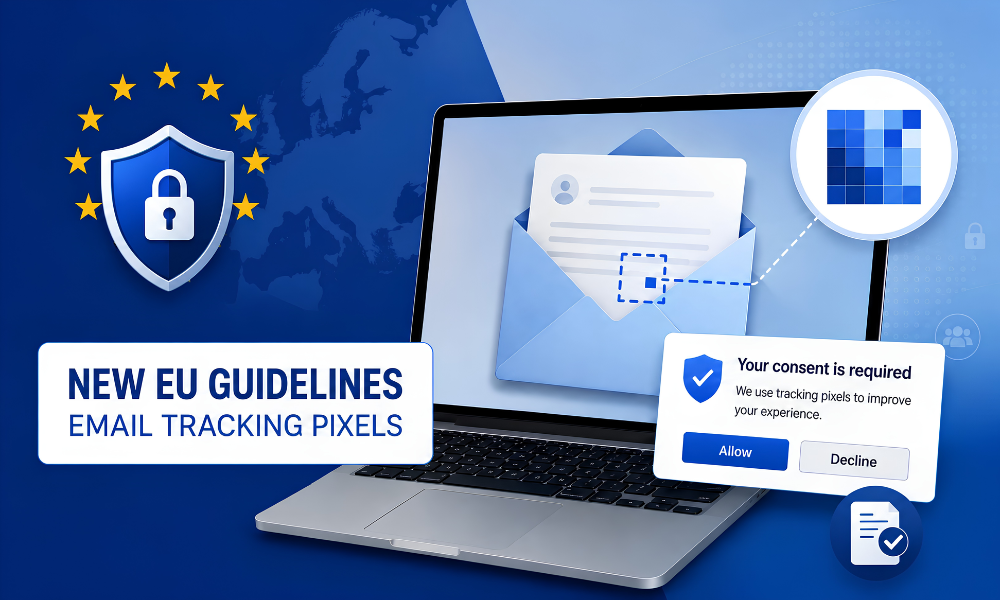
Email tracking pixels have been a top feature used by marketers to analyze email open rates, device type, and geographic locations of receivers. Marketing and sales teams often consider it a crucial metric to analyze that helps in measuring campaign performance, improving approaches, adopting personalization, and aiming for more impactful email marketing campaigns.
However, the data protection guidelines of different regions affect how tracking pixels are used by marketers. Recently, the European nations France and Italy have introduced new guidelines, according to which marketers will have to obtain explicit consent to use tracking pixels while analyzing email open rates.
The laws are applicable to individuals living in these countries. So, when anyone outside sends an email to recipients residing in France and Italy, they will require consent to track the open rate through pixels. The step will have a significant impact across marketers and their email marketing initiatives targeting the mentioned European countries.
In this blog, we will dive into the new consent guidelines of France and Italy, alongside analyzing what marketers need to do to stay compliant and execute successful email marketing campaigns. First, let us understand what email tracking pixels are and how they work...
What are Email Tracking Pixels?
Email tracking pixels are tiny, invisible 1x1 pixel images embedded inside marketing emails. They load automatically when a recipient opens an email and works as a key metric to assess email open rate. Once the email is opened, the feature sends information back to the sender’s server.
Pixels works as data that confirm whether the email was opened alongside recording details like the opening time, device type, email client, IP address, and approximate location. Each pixel usually contains a unique identifier linked to an individual recipient. Marketers use this information to measure campaign performance and improve engagement. However, European regulators now classify many uses of email tracking pixels as personal data processing that requires prior consent.
How do Email Tracking Pixels Work?
Each email contains an invisible image hosted on the sender’s server, and the image includes a unique URL connected to the recipient. When the recipient opens the email, the email client requests the image from the server. That request records the email open and captures technical information.
Depending on the configuration, marketers can see the open time, operating system, device, and more. Many automation platforms use this information to trigger follow-up emails, lead scoring, or audience segmentation. Nevertheless, privacy features from several email providers already limit tracking accuracy, making open rates less reliable than before.
EU’s New Consent Guidelines for Email Tracking Pixels
France and Italy have introduced stricter privacy rules for email tracking pixels used in marketing emails. The guidance follows the principles of the ePrivacy Directive and GDPR. Both regulators believe tracking pixels can access information stored on a user’s device. Therefore, many marketing uses require explicit consent before tracking begins.
France's Consent Guideline:
CNIL is France’s data protection authority that has recently made an important announcement about the use of tracking pixels. On April 14, 2026, they laid down final recommendations, highlighting that marketers will need to attain prior consent before using these tracking tools.
Tracking pixels can be really helpful for activities like monitoring how well campaigns are doing, analyzing audiences, creating profiles, and personalizing marketing efforts. However, it’s crucial that the consent given by users is clear, informed, specific, and easy to retract.
The CNIL has also mentioned a transition period for email addresses collected by marketers before April 14, 2026. It allows organizations to use tracking pixels if they make sure to give recipients clear information and an option to opt out. This typical transition period ended on July 14, 2026, but extensions are possible if organizations can prove they faced operational challenges.
Italy’s Consent Guideline:
Italy's privacy regulator, Garante, took a similar step to CNIL with Provision No. 284 on April 17, 2026. Like the CNIL, they require explicit consent for any identifiable marketing tracking and have given organizations a six-month window to adjust their practices, with a compliance deadline set for October 28, 2026.
Notably, these regulations depend on where the recipients are residing, not where the sender is based. So, you still need to follow these rules when reaching out to individuals in France or Italy even if you are a business outside of Europe. The step makes compliance a must for global marketing teams.
Nevertheless, there are some exemptions as per the new guidelines. Pixels used entirely for security, authentication, and essential email delivery may not require consent. However, marketers need to carefully assess each situation before relying on an exemption.
Why is the New Consent Guideline Necessary?
Email has always been viewed as a private communication channel. However, most recipients do not expect invisible technologies to monitor when they open a message. For these reasons, regulators believe users deserve greater transparency and control over these practices.
Email tracking pixels can reveal more than an email open. They may collect device details, IP addresses, timestamps, and locations of the recipients. Such data can create detailed user profiles when merged with other customer information. Privacy authorities believe such processing should happen only with informed consent.
The stricter regulations in France and Italy are indicative of bigger changes in digital privacy. Restrictions on browsers, Apple’s Mail Privacy Protection, and more resilient global privacy bodies have already decreased dependence on open rates. As a result, regulators now recommend businesses implement more transparent measurement methods.
Another factor responsible for this change is the consistency of guidelines. Significantly, cookies are already subject to consent under European privacy regulations. The CNIL and Garante indicate that email tracking pixels operate in a similar manner by collecting information from users’ devices. In this context, establishing comparable consent requirements sustains a more uniform privacy framework across digital channels.
What is Changing and What is Not?
The biggest change is that marketers can no longer rely on implied consent for marketing email tracking pixels in France and Italy. If the pixel measures email opens, campaign performance, or user behavior, recipients must first provide explicit consent in most cases. Consent must also be separate from other marketing permissions and easy to withdraw.
The guidance does not ban email tracking pixels entirely but changes the legal basis for using them. Marketers can continue using pixels after attaining valid consent. This approach allows organizations to track engagement while adhering to users’ privacy rights.
Nevertheless, some activities remain unchanged. Essential pixels used for security, authentication, fraud prevention, or email delivery may not require consent because they serve technical purposes instead of marketing. These exemptions are narrow and should not be applied broadly.
The new guidelines also do not prohibit other performance metrics. Marketers can still measure click-through rates, conversions, website activity, purchases, and customer journeys when they comply with applicable privacy laws. Many experts now recommend shifting attention toward these engagement metrics instead of relying heavily on open rates.
How Will It Impact Your Email Marketing Strategy?
The requirement of explicit consent for tracking pixels in France and Italy has created tension among marketers who target audiences located in these countries. Many businesses will notice lower reported open rates because some recipients may decline consent for email tracking pixels. This could affect campaign reports, lead scoring, automation triggers, and audience segmentation. Marketing teams should avoid treating email opens as their primary success metric. Instead, they should focus on clicks, conversions, purchases, website engagement, and customer retention. These indicators provide stronger evidence of campaign performance.
Businesses operating globally also have to identify recipients based in France and Italy. Consent management should be initiated according to the recipient’s location. Companies cannot ignore these rules simply because they operate outside of Europe. The changes also encourage marketers to build stronger customer trust. Transparent communication about data collection can improve subscriber confidence and support long-term engagement.
What Should Email Marketers Do?
If you are a marketer targeting audiences across France and Italy, and think that the fresh consent guidelines can impact your email campaign, here are the steps to follow-
- Start by reviewing how your organization uses email tracking pixels. Identify where tracking supports analytics, personalization, or automated marketing workflows.
- Update your consent process to collect explicit permission before enabling tracking recipients covered by these rules. Keep clear records of when and how consent was obtained. Make it simple for users to withdraw consent at any time.
- Review your email platform and marketing automation tools. Many providers are introducing settings that allow tracking preferences to be managed at the individual contact level.
- Finally, diversify your reporting strategy. Measure clicks, conversions, customer lifetime value, and revenue instead of depending only on email opens. This approach supports better decision-making and prepares your marketing strategy for future privacy regulations.
Designing Compliance-Centric Email Campaigns!
Privacy expectations continue to evolve across digital marketing. The latest rules around email tracking pixels show that transparency and user choice are becoming essential for successful email campaigns. Businesses should view compliance as an opportunity to build stronger customer relationships instead of treating it as a regulatory burden.
Marketers can continue delivering effective campaigns by collecting valid consent, improving first-party data strategies, and focusing on meaningful engagement metrics. Organizations that embrace the changes early will be better prepared for future privacy changes while maintaining customer trust and long-term marketing performance.
KnowledgeNile aims to analyze complex technologies, simplify them, and deliver them so that you can understand and implement them effectively. Visit our site and stay updated with emerging technologies.
FAQs:
1. Can you put a tracking pixel in an email?
Answer: Yes, you can put a tracking pixel in an email across all HTML-supported email service providers, including Gmail, Microsoft Outlook, Apple Mail, and Yahoo Mail.
2. Can you tell if an email has a tracking pixel?
Answer: Yes, you can tell if an email has a tracking pixel by inspecting its raw HTML source code for tiny external images.
3. Are tracking pixels legal in emails?
Answer: Yes, tracking pixels in emails are legal but are highly regulated in specific nations such as France and Italy.
4. How to create a tracking pixel for email?
Answer: You can create tracking pixels for email using email marketing platforms or tracking tools that generate a unique pixel code. Add the code to your email, and when the recipient opens it, the pixel records the open and sends the data to your analytics dashboard.
Also Read:
How to handle the irreverence of Email Unsubscribes
Top 10 Free Email Marketing Platforms
Five email marketing automation mistakes you’re probably making