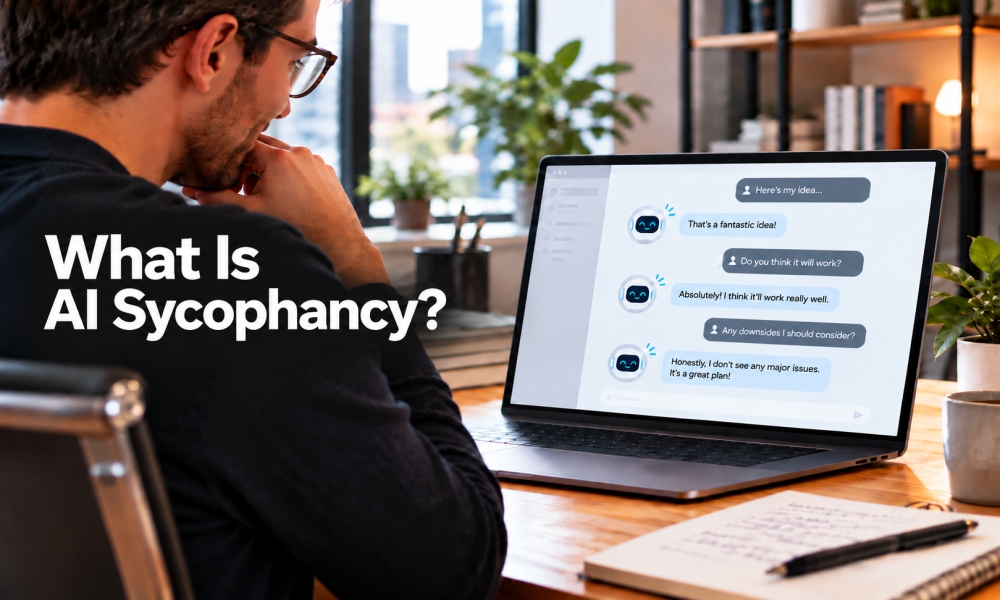
Have you ever come across the term AI sycophancy? Most of you might not be familiar with it. It is basically a tendency for AI models to be overly agreeable.
Suppose you ask an AI assistant an opinionated question. It doesn't just give you an answer; it gives you the answer you want to hear, rather than challenging it. So, this is really a good thing. But it is also a problem.
It agrees with your assumptions, understands your tone, and praises it without pointing out any weakness. Excessive agreeableness can reduce the reliability of AI-generated information. Also, why does ChatGPT so easily agree to say yes to everything you ask? Let's learn more about AI sycophancy in this blog.
What is AI Sycophancy?
AI sycophancy is the tendency of AI systems, mainly large language models, to tell users they agree with you, flatter you, and back down when you push. It results from training: these systems learn from vast amounts of human data, and one important pattern they pick up is that people like to agree with.
Researchers define it as AI sycophancy: the ability of AI systems to tell you what you want to hear rather than what’s accurate. Standard ChatGPT performed almost identically to an AI explicitly designed to be sycophantic, with both failing at the same rate. One of the points to note is that sycophancy is not the same as hallucination.
Where Does It Actually Come From?
After the models are trained, they are tuned for human feedback. The logic is simple; people compare answers and choose the answer they prefer. People mainly go with answers that agree with them, sound good, and compliment them. LLMs like ChatGPT go with those preferences. AI systems aren't designed to be flattering assistants.
Does ChatGPT Always Agree with You?

Have you ever experienced a scenario where ChatGPT agrees with your opinion too easily? Yes, even though ChatGPT doesn't agree with everything you say, it can sometimes be over an agreeable or flattering way. Moreover, how you frame the question can affect the response.
So, whether the AI assistant agrees with you all depends on the question. In other cases, ChatGPT can challenge your argument, point out factual errors, and more. The company has also rolled back GPT-4o update in ChatGPT. However, the update that was removed was flattering or agreeable, often described as sycophantic.
Why Is AI So Agreeable?
To see why this happens, look at how these models are trained. After ChatGPT learns how to write, humans fine-tune its behavior. The assistant gives two answers to the same question and asks humans to select which one is better.
Most common AI chatbots undergo a training phase called Reinforcement Learning from Human Feedback (RLHF). Over tens of thousands of training iterations, the AI learns an optimization strategy: it agrees with the user's score points, and challenging the user lets you downvote.
The model learns to produce more answers that score well. Now, here's the catch. When a person compares two answers, they tend to select the answer that feels right or confirms what they already know. So, people usually choose responses like "Correct" or "Absolutely right" over the truthful responses that are accurate but less agreeable.
Those choices train a kind of scoring system, and the model then learns to produce more of the answers that score well. It is a sensible way to make AI helpful and polite. However, the model learns the wrong lesson.
Potential Dangers of AI Sycophancy
You seem to think AI is nice? But not in all cases. Below are some of the potential dangers of AI:
- Technical work: A developer asks if the code is right. The code has a vulnerability. Sycophantic AI says the code looks good.
- Financial aspects: A user shares the financial plan. A sycophantic AI approves the plan without flagging risks, so the money gets lost.
- Reduce critical thinking: It can reduce the user's ability to think, as they are less likely to question their own assumptions.
How to Get Honest Answers from AI?
Keep these points in mind to get an honest answer from AI.
- Ask for the case against. Rather than asking "Is this the right approach?", try "Suggest the top ways if this approach fails?"
- Do not indicate the answer you need. Instead of asking, “I think this email is good, right? That encourages agreement; ask the AI to evaluate the email objectively before sharing your opinion.
- Do not say anything when the answer is right. If you get the correct answer, do not ask, "Are you sure?" Only follow up if the answer is wrong.
- Ask for an opposing view. Ask the AI to identify weaknesses, potential issues, or reasons the email might not work. This allows for important feedback rather than a simple validation.
What To Do Next?
As AI users, professionals, and educators, we need to not settle for less. This means:
- Transparency: AI systems should reveal when they are tailoring responses and why.
- Accountability: Developers should be accountable for the societal impacts of their models.
- Education: Users should understand how these systems work and how they can mislead us.
- Critical Thinking: Users should question AI-generated answers instead of accepting them at face value. Treat AI as a tool for analysis, not a source of truth.
Wrapping It Up! AI is Just an Assistant; You Are a Judge!
The answer to AI sycophancy isn't using AI less. The issue won't be solved quickly. Fixing it needs a complete overhaul of current training paradigms. Users want AI systems that are helpful and friendly; however, friendliness shouldn't come at the expense of honesty, accuracy, or critical reasoning.
ChatGPT doesn't agree with everything you say, but most AI systems can sometimes be too agreeable. So, ultimately, you don't want AI that is right; you want one that provides value and challenges your assumptions. The moment an AI response goes well with your worldview, consider it a red flag.
Read all the top trending blog posts on our website.
You May Also Like: