
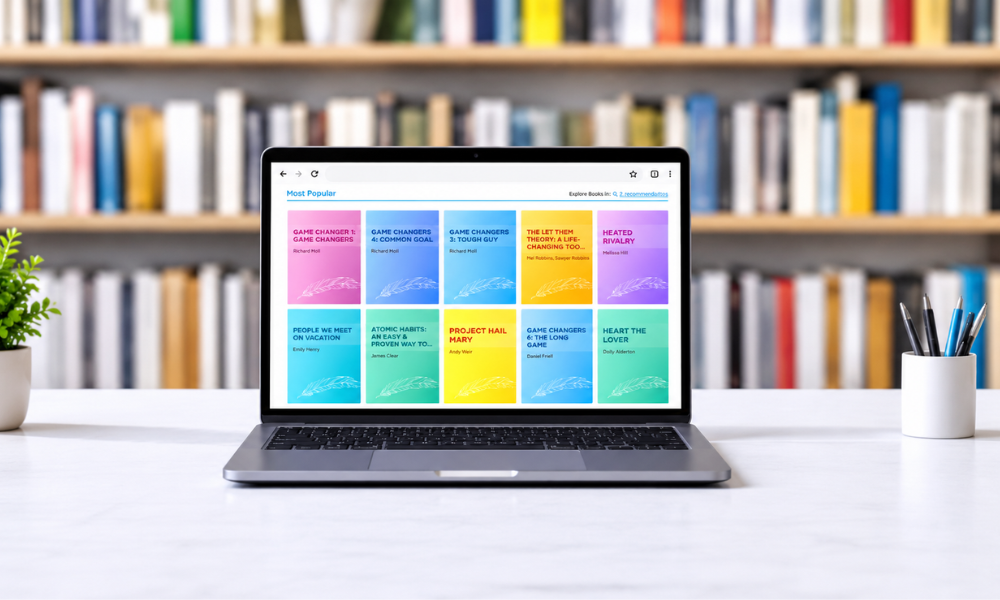
Semantic search helps readers find relevant books across large digital collections by interpreting meaning rather than matching words alone. It identifies subjects, themes, reading intent, and relationships between books; recommendation systems then suggest titles using metadata and reader behaviour. These results are starting points, not proof that a book is authoritative, accurate, or legally available.
How semantic search finds books by meaning
Traditional keyword search looks for the terms entered and ranks records containing them. That works well when you know a title, author, or exact phrase. It is less helpful for a broad request, such as “accessible climate fiction about migration” or “introductory books on the history of public health”.
Semantic search represents text as numerical patterns called embeddings. These capture relationships between words and passages, allowing a system to compare a query with descriptions, contents, and sometimes the full text of books. A search for climate fiction might return novels described as ecological dystopias or stories about environmental displacement, even when the phrase “climate fiction” is absent from the record.
Metadata also matters. Subject headings, publication dates, language, format, author names, and cataloguing quality give the system useful structure. Poor OCR, missing fields, inconsistent spelling, and ambiguous language can still produce weak results. A scanned book with unreadable text may be invisible to semantic search.
How Z library-style discovery combines search with recommendations
Search answers a stated request. Recommendation systems continue the process after a reader finds a promising book. A system might suggest works by the same author, books sharing subjects, newer editions, translations, or titles read by people with similar patterns.
Content-based filtering compares features of a selected book. Collaborative filtering uses patterns across readers, such as titles frequently viewed or borrowed by people who chose the same work. Metadata-driven systems rely on catalogued subjects and bibliographic relationships. These methods can overlap, and their results depend on collection coverage and consistent records. Explicit feedback, such as ratings or saved titles, can also influence recommendations.
A reader using Z lib or another discovery interface might move from one relevant result to related authors and subjects. That path can reveal books missed by the original query, but the interface alone says nothing about copyright status, licensing, or the legality of accessing a particular copy.
Popularity can shape recommendations. Well-known books and titles with detailed descriptions may receive more exposure than obscure works with sparse records. Personalization can also return familiar subjects repeatedly instead of adjacent perspectives.
Why AI book discovery still needs human checks
Semantic similarity is not a quality rating. A result may resemble a reliable research book while containing weak evidence, outdated claims, or an unsuitable reading level. Automated or imported catalog records can contain errors, so verify authorship, dates, and subject labels against a reliable source.
Digital collections may include duplicate editions, translations, abridgements, and different file formats. These records can make a collection appear larger while obscuring which version is complete or suitable. Before relying on a title, confirm its author, publisher, edition, language, and publication details.
Access is separate from discovery. Copyright and licensing rules vary by country, collection, and edition. A search for Free books does not establish that a copy is legally available at no cost. A Free library may refer to different kinds of collections, so check the terms for each title. Personal data also deserves attention: consult a service’s current privacy policy rather than making assumptions based on its AI features.
A practical way to search a large digital collection
Start with a natural-language description of your need, then narrow results using author, date, language, subject, and format filters. Read several records rather than choosing the first match. Follow recommendations selectively, checking whether each suggestion is relevant or merely popular.
Comparing interfaces such as Zlib can show how different services present their interfaces, but it does not establish the accuracy, safety, or lawful availability of any listed file. Use lawful access routes, limit personal information shared with search services, and treat AI recommendations as leads for further checking.
Recommended Reading:
The Power of Market Research in the Higher Education Sector
How Does Modern Note Taking Approach Molds with Digital Revolution