Every team building a smart product faces the same problem sooner or later. A hospital uses a wearable to detect unusual heartbeats. A warehouse installs cameras to spot damaged packages before shipping. A retailer uses a chatbot that can answer customer questions at any time.
All three solve different problems, but they all need to decide whether inference should occur on the cloud server or on the device itself. Edge AI vs cloud AI inference is more than a choice between two options. The best choice depends on your requirements.
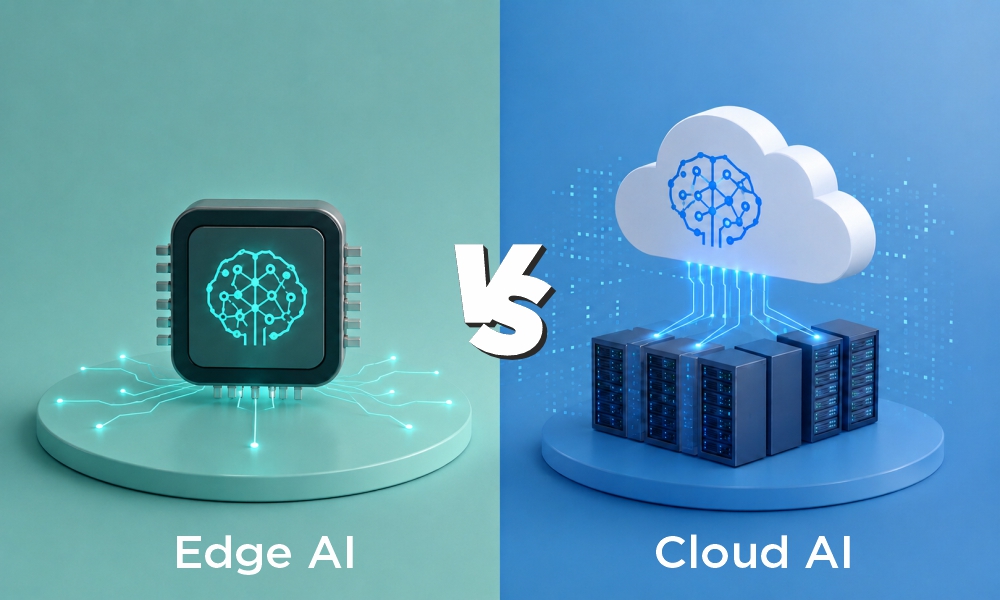
In simple terms, edge inference means a model runs on the device or nearby edge system, such as a wearable, sensor, or a camera. With cloud inference, the device sends data to a remote server for processing, and the server returns the result to the device.
Neither approach is automatically better. The right choice depends on response speed, device capabilities, data requirements, and what happens when the internet connection fails.
Edge AI vs Cloud AI Inference: What's the Difference?
| Factor | Edge AI Inference | Cloud AI Inference |
| Where processing takes place | On the device or on a nearby edge system | On a remote cloud server |
| Response Speed | Typically, faster because data does not need to make a round trip to the cloud | Depends on network speed and server response time |
| Internet Necessity | Can work without internet, depending on the setup | Usually requires a network connection |
| Cost pattern | Higher upfront hardware cost, potentially lower ongoing costs | Lower device cost, but ongoing costs increase with usage |
| Data Location | Data stays on the device | Data travels to a remote server |
| Model size and computing power | Limited by available device computing resources | Better suited to large and computationally demanding models |
| Model updates | Updates may need to reach individual devices | Updates can be managed centrally |
| Best suited for | Real-time, offline, safety-sensitive, or privacy-sensitive tasks | Complex, resource-intensive tasks that can tolerate network latency |
| Common examples | Medical wearables, smart cameras, vehicle systems, factory sensors | Customer service chatbots, recommendation systems, large-scale data analysis |
What Does Inference Actually Mean?
Training a model and running a model are two different things.
Training means how a model learns from data. It usually requires a lot of computing resources and happens once or periodically. At the same time, inference is the process of using a trained model to generate a result. A smartphone recognizing your face, a bank flagging a suspicious transaction, or an email service filtering spam are all examples of inference.
This difference matters because inference happens repeatedly. As your product gets more users, the number of requests increases.
That's why where inference happens can matter as much as how the model is trained.
When Should You Use Edge Inference? The Hospital Wearable Example
Imagine a wearable that tracks a person's heartbeat and needs to respond instantly. Sending data to a remote server first can introduce a delay that matters in time-sensitive situations.
This is why many medical wearables perform some processing on the device itself while relying on cloud infrastructure for deeper, long-term analysis.
This is a key benefit of on-device inference: faster responses because the data doesn't have to travel to the cloud and back. The same principle applies to cars, industrial equipment, robots, and other systems where even a small delay can matter.
When Should You Use Cloud Inference? The Retail Chatbot Example
Now consider a customer service chatbot. It doesn't always need a response within milliseconds. Here, the focus is less on instant responses and more on access to up-to-date data and a model capable of handling complex questions.
This is where cloud inference is often a better fit. Cloud AI inference offers more access to computing power and easier updates. It also lets businesses update the model in one place rather than updating each device separately. Complex tasks that don't require instant results are often a good fit for cloud processing.
When Should You Use Hybrid Inference? The Warehouse Camera Example
The warehouse camera shows why edge vs cloud inference doesn't have to be an either-or decision.
The camera can do basic processing on its own. It can detect a package, spot a clear problem, or flag an image for further review.
If something looks unusual, the image can be sent to the cloud for deeper analysis. The results can then be stored and compared across warehouses to spot larger quality issues.
This setup keeps routine processing on the device while offloading more demanding tasks to the cloud. The device makes the immediate decision; the cloud handles heavier processing and deeper analysis.
Edge AI vs Cloud AI Inference: Which One Should You Choose?
Neither option is always better. The best choice depends on your product's needs, how quickly it must respond, and where the data needs to be processed.
Choose edge AI inference if:
- A slow response could affect safety, performance, or the user experience.
- The device needs to work with a weak or unavailable internet connection.
- You want sensitive data to stay on the device.
- The task can run well with a smaller, efficient model.
Choose cloud AI inference if:
- The task needs a large or compute-heavy model.
- A small network delay won't significantly affect the user experience.
- You need to combine data from many devices or users.
- You want to manage and update the model from one central place.
Choose both if:
- Some decisions need to be made quickly, while others require more computing power.
- You want local processing for privacy or reliability, but cloud processing for deeper analysis.
- Your product needs to scale without putting every task on a single system.
For many products, a hybrid approach can be the most practical choice.
What to Remember?
Businesses treating edge AI vs cloud AI inference as an either-or choice end up with a product that is either too expensive or too slow. A better approach is to split tasks. Fast, private, and safety-critical tasks stay on the device. Resource-heavy, less time-sensitive, and complex tasks can be sent to the cloud.
Before building any product, you need to ask three questions: What needs an instant response? What can wait? What data should stay on the device? These decisions can also change over time. As devices become more powerful, tasks that once required the cloud can move to the edge. Keeping your setup flexible can help you avoid costly changes later.
Want to know more? Explore our official website today.
FAQs
1. What hardware does edge AI inference need?
Answer: It depends on the task. Edge devices may use a dedicated chip, such as an NPU or an accelerator, to run models locally. Many modern phones and industrial sensors already have this hardware built in.
2. Can the same model run on both edge and cloud?
Answer: Yes. A model can often run in both environments. The edge version may need to be optimized to be smaller and more efficient.
Recommended For You: