
Modern business workloads are distributed across public, private, and on-premises infrastructure. Hybrid cloud networking is an infrastructure that securely connects two or more distinct cloud environments, enabling distributed environments to operate as a unified infrastructure.
One of the major advantages is that it allows organizations to communicate smoothly across regions. It helps in maintaining uniform results and visibility across their infrastructure. By incorporating a strong networking foundation, workloads can move efficiently while maintaining a stronger security posture and operational continuity.
Let us dive into the entire blog to know how hybrid cloud networks help us move workloads without compromising security.
Understanding Hybrid Cloud Networking
Hybrid cloud networking is basically a combination of different computing environments, including private-cloud, public-cloud, and on-premises infrastructures. A hybrid cloud environment allows organizations to benefit from different cloud deployment models.
For example, scalability that comes with public cloud, control, and robust security that comes with private or on-premises architecture. Hybrid cloud networking is ideal for organizations that need to have control over their data while unlocking the flexibility and cost-effectiveness of cloud computing. Moving to hybrid clouds is important as it helps in efficient workload portability, managing data effectively, while focusing on security. It helps organizations move data seamlessly between on-premises and cloud environments with no compromise on security.
Importance of Workload Portability
Workloads are constantly increasing due to demand, user traffic, and operational requirements. When services rely on a single cloud environment, flexibility can be limited, and infrastructure management may become more complex. Precisely for this reason, businesses are increasingly prioritizing workload portability in hybrid cloud networking. As per the reports, the hybrid cloud business is predicted to reach 262 billion U.S. dollars by 2027.
Workload portability enables organizations to respond more quickly to fluctuating workload conditions. As workloads become more dynamic, organizations will require a more seamless work environment, consistent performance, and secure connectivity across their hybrid cloud infrastructure.
In addition, workload portability supports disaster recovery and the backup landscape by enabling workloads to move across environments during infrastructure failures, helping to maintain business continuity.
It also helps organizations maintain control over infrastructure costs, improve performance, and allocate resources more efficiently.
Network Operations That Keep Workloads Moving Smoothly
A hybrid cloud networking environment is designed to maintain connectivity, performance, and synchronization among all platforms. Several networking operations work simultaneously to ensure applications continue operating without interruption while maintaining consistent network security across environments.
One of the most important components is intelligent traffic routing. Hybrid cloud networks manage data transfer flow. Workloads need to remain stable even when applications are distributed across multiple infrastructures. Container orchestration platforms such as Kubernetes improve workload mobility.
Load balancing is a key part of workload portability in hybrid cloud environments, as it helps to distribute traffic across multiple systems. It aids in maximizing resource usage and ensures consistent performance.
Furthermore, hybrid cloud networking maintains continuous synchronization between environments with secure inter-cloud communication.
Successively, these networking operations create a connected ecosystem, enabling workloads to be moved efficiently across environments while maintaining performance, scalability, reliability, and stronger network security.
Security Challenges that Arise as Workloads Move Across Hybrid Environments
When applications and data are transferred between different environments, such as public and private clouds and our on-premises systems, new security issues arise each time. As a result, companies must protect a wide range of assets simultaneously, including their network environment, various platforms, and how systems communicate with each other. Furthermore, continuous monitoring is necessary to keep the entire operation stable and properly managed.
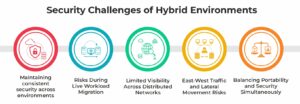
Some of the major security challenges include:
1) Maintaining consistent security across environments
Various infrastructures commonly follow different networking and security outlines. These configurations generate security gaps during workload portability.
- Firewall guidelines may differ across cloud platforms.
- Minor network errors may expose the workload during migration.
2) Risks During Live Workload Migration
- Insecure migration paths can be the entry point for attackers.
- Confidential data can be disclosed through unregulated communication.
- Security can get weak due to non-encrypted authentication, thereby introducing vulnerabilities.
3) Limited Visibility Across Distributed Networks
- Security teams may find it difficult to evaluate workload activity in real time.
- Monitoring blind spots may be created by multiple cloud providers.
- Delayed threat detection may increase operational risks.
4) East-West Traffic and Lateral Movement Risks
- Security risks can spread all over the infrastructure due to poor segmentation.
- Shared network access may increase exposure between connected systems.
5) Balancing Portability and Security Simultaneously
- Security policy must maintain a consistent approach across all cloud environments.
- Ongoing monitoring is vital throughout the transition of workloads to new locations.
Organizations need networking architectures that support both workload portability and enhanced security without impacting performance or operational continuity.
Building a Hybrid Cloud Networking Infrastructure that Balances Portability and Security
Hybrid cloud networks play a vital role in helping organizations move workloads to cloud environments. Instead of treating portability and security as separate goals, modern hybrid cloud networks integrate both capabilities within a single infrastructure.
One of the most effective ways to create standardized networking policies for all cloud environments. When security policies and communication regulations remain consistent, workloads can shift more smoothly without creating any security concerns.
Organizations are widely adopting Zero Trust principles among hybrid cloud networks. Instead of trusting those shifting workloads inside the network, every attempt is persistently checked, thereby reducing any risk of unauthorized access.
Another important aspect is automation. Automation is becoming a part of managing workloads to maintain security and workload portability. Automated network policies help organizations manage workload security faster and reduce vulnerabilities. These secure network strategies, with workload portability, help maintain operational continuity.
Industry Use Cases of Hybrid Cloud Networking for Portable Workloads
Hybrid cloud networks are becoming important for upholding workload portability and security operations. Various industries use hybrid cloud environments to securely shift their workloads while ensuring sensitive data and critical applications remain protected.
1. Healthcare:
The healthcare industry handles a large amount of sensitive data across multiple systems and locations.
Hybrid cloud networks enable secure transfer of workloads between hospitals, cloud platforms, and data centers. Workload portability enables improving access to healthcare applications across the entire infrastructure.
2. Financial Services:
The financial industry requires both strong security measures and adaptability controls for critical workloads. During the peak transaction point, hybrid cloud networks balance high-performance workloads with security measures. It also supports compliance and risk management requirements.
3. Media and Streaming Platforms:
Media organizations use hybrid cloud-based networks to distribute their content across multiple geographic regions. This infrastructure makes it easier for broadcast services to handle shifting workloads while maintaining scalability.
Wrapping Up
As businesses continue to adopt hybrid cloud networking practices to manage workloads, demand for secure, flexible network infrastructure is increasing rapidly. From intelligent traffic management to automated security controls, workload shifting across hybrid clouds provides organizations with a cost-effective, efficient way to deliver workloads while securing their resources and delivering the best possible performance.
For more insightful blogs please visit our official website now!
FAQs:
1. Why is workload portability important in hybrid cloud networking?
Answer: Workload portability allows businesses to move applications and services across multiple geographic regions. It helps in achieving better scalability, disaster recovery, operational flexibility, and resource optimization.
2. How does hybrid cloud networking improve security?
Answer: It uses encryption and strong access control mechanisms to maintain secure and consistent operation across connected platforms.
3. How does Kubernetes support workload portability in hybrid cloud environments?
Answer: Kubernetes supports workload transfer and scaling in a hybrid cloud environment by making it easier for businesses to deploy and manage portable workloads consistently across their diverse infrastructures.
Recommended For You: