
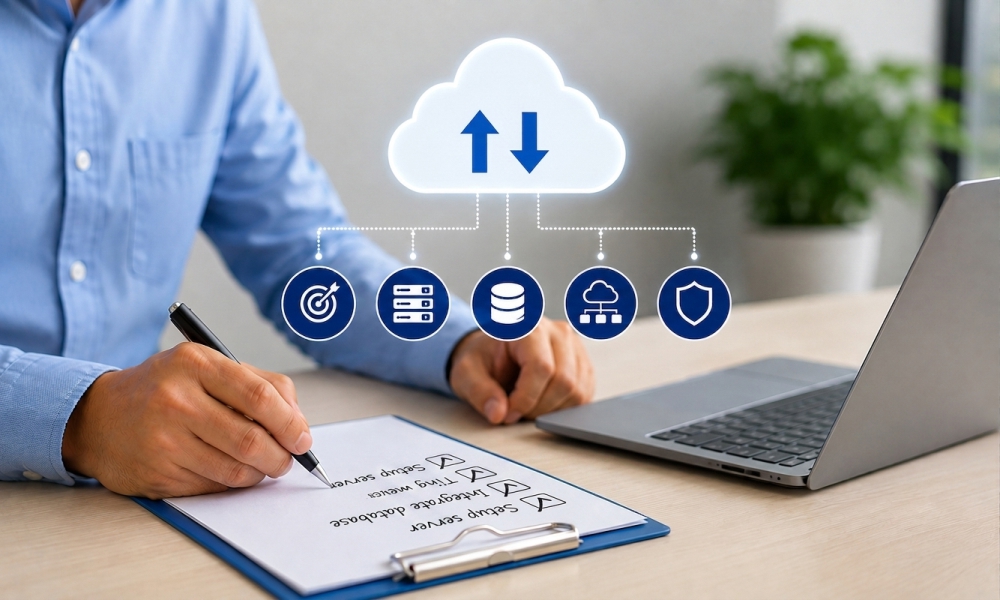
Businesses today are moving to the cloud platform due to the strategic benefits it offers. But do you know that migrating to the cloud without a readiness checklist can lead to costly setbacks?
If you are struggling to know how to move your mid-size business to the cloud without disrupting operations, we’ve got the answer in this blog.
It is essential to craft a solid cloud migration strategy that aligns well with legacy systems and ensures cloud readiness. According to industry data, the cloud migration services market has grown rapidly in recent years. It grew from $268.02B in 2025 to $330.27B in 2026 with a CAGR of 23.2%. This blog is curated to help you understand the cloud migration checklist to kickstart your way towards cloud success and boost business growth. Let’s get started.
Why Do Mid-Sized Companies Need a Cloud Readiness Checklist?
Unlike startups, enterprise companies cannot move quickly to a new platform, such as the cloud, without careful planning. Mid-size companies stand somewhere between; they need higher reliability, performance, security, and more without breaking the bank.
Your cloud readiness checklist must fulfill everything right from speed, stability, minimal business disruption, governance, and more. This balance doesn’t come from generic cloud migration steps. It comes from framing the right business objectives, assessing your existing infrastructure, network and connectivity, compliance requirements, and team capabilities. Let’s dive in to explore the cloud migration readiness checklist that works best for your mid-sized enterprise.
The Ultimate Cloud Migration Checklist for Mid-Sized Enterprise Success
1] Define Your Business Objectives
Clarify why you are migrating to the cloud. What is your objective behind moving to a new platform? Some of the frequent factors of migration are the need to lower the infrastructure cost, boost application performance, boost business agility, retire data center hardware, and applications that demand cloud capabilities.
Some of the key questions to ask are:
- Will migrating to the cloud lead to cost reduction and operational efficiency?
- What are the common business issues this migration will resolve?
- Is your main target, public, private, or hybrid-cloud infrastructure?
- Is disaster recovery your priority?
- Are you modernizing legacy applications?
Business Objectives Checklist:
- Define business outcomes.
- Set measurable KPIs.
- Identify the expected ROI.
- Prioritize workloads based on business value.
2] Assess Your Existing IT Infrastructure
Your cloud migration checklist starts with knowing what you are actually moving. It is necessary to perform a full audit of not just your applications, but of everything including databases, integrations, and systems. Many mid-size companies are surprised by the technical debt found during the migration assessment.
Before migration, make sure to follow these steps:
Assessing IT Infrastructure Checklist:
- Analyze network bandwidth.
- Assess servers and hardware performance.
- Identify software dependencies and licensing agreements.
- Map third-party integrations.
- Remove obsolete systems.
3] Evaluate Application and Data Readiness
Not all applications are migrated in the same way, and even assuming that all workloads are similar is one of the biggest mistakes when planning a cloud migration. Make sure to classify your applications and assess every workload using the 6R framework.
- Rehost (Lift and Shift): Move the application to the cloud with minimal changes.
- Replatform: Make minor cloud optimizations to the application before migrating, without changing its main architecture.
- Refactor: Redesign the complete application to take advantage of the cloud-native features, performance, and scalability.
- Repurchase: Purchase a SaaS cloud solution with the same functionality to replace the current application.
- Retire: Remove unused applications to reduce migration effort and overall costs.
- Retain: Keep certain applications on premises to meet compliance or technical requirements.
Application and Data Readiness Checklist:
- Classify every application using the 6R framework.
- Check which workloads can be rehosted with minimal changes.
- Flag applications that need refactoring.
4] Review Security and Compliance Requirements
Security and compliance are one of the top concerns for businesses, mainly in regulated industries such as healthcare, finance, government, and more. Discovering a compliance blocker during a migration can bring the project to a standstill, resulting in costly delays and potential reputational harm.
Security and Compliance Checklist:
- Make sure the cloud provider you are considering has the certifications that meet your compliance needs.
- Identify data privacy laws including GDPR, HIPAA, PCI-DSS, SOC2, and ISO 27001. Ensure all the regulations are applicable to data assets and applications.
- Review the logging and auditing framework
5] Network and Connectivity Readiness
Your network architecture can make or break your cloud performance. So, it is essential to assess your current bandwidth, reliability, and latency requirements for critical applications. Remember, low connectivity impacts cloud performance.
Network and Connectivity Checklist:
- Evaluate load balancing, CDN, and routing needs of customer-facing applications.
- Gauge VPN Connectivity, Direct Connect or ExpressRoute options.
- Identify latency constraints in heavy applications.
6] Cost Analysis and Budget Planning
Cloud cost is always a surprise. Your cloud migration readiness checklist should include the real cost modeling, not the vendor estimates. Ensure you have a solid FinOps plan in place before the cloud migration begins. It helps to control the following:
Cost and Budget Checklist:
- Forecast TCO (Total Cost of Ownership).
- Set budget alerts and policies.
- Consider migration expenses including:
- Training costs
- Storage fees
Without proper cloud cost governance, developers will launch resources without keeping cost in mind.
7] Choose the Right Cloud Deployment Model
Closely evaluate which deployment model fits your enterprise needs. You can choose from:
- Public cloud for cost efficiency and scalability.
- Private cloud for customization.
- Hybrid cloud for legacy integration and gradual modernization.
Cloud Deployment Model Checklist:
- Compare private, public, and hybrid clouds against your business requirements.
- Consider a multi-cloud approach to avoid vendor lock-in.
- Evaluate long-term scalability and cost of every model.
8] Team Skills and Training
In addition to technology readiness, there is people-readiness. Determine if your team is equipped to maintain cloud environments and identify gaps in their knowledge. Preparing cloud skills before migration will contribute to successful migration and future success.
Team Skills and Training Checklist:
- Plan training programs that assist the team in the migration process.
- Audit your current team’s skills against the cloud requirements.
- Check for knowledge gaps across cloud architecture, DevOps, and more.
Start Moving from Cloud Migration Checklist to the Strategic Action!
Cloud migration is a revolutionary approach for mid-sized companies; however, success depends on careful planning rather than moving workloads to a new environment.
Closely evaluating infrastructure and addressing existing system limitations before migration is equally important. It can surely help your mid-size company to reduce risk and achieve a smoother transition. Don’t forget to follow the above-mentioned cloud migration checklist as your roadmap towards a cloud-empowered future.
To read more about such tech related blog posts, don’t miss out on visiting our website.
FAQs
1] How long does cloud migration take?
Answer: It depends on the organization’s complexity and size. The cloud migration process can take from weeks to several months.
2] Why is cloud migration checklist important?
Answer: A checklist helps to identify risk, control costs, reduce downtime, and make sure all technical and business requirements are addressed before migration.
Also Read:
Myths about Moving to the Cloud Storage
5 Real Life Examples of Hybrid Cloud
Hybrid Cloud Networking for Workload Portability and Enhanced Security