
Organizations face many cyberattacks despite strong security practices. Cyber threats are becoming more sophisticated. Organizations must carefully consider how to manage their security operations. Cybersecurity teams do not struggle because they lack security tools. The biggest challenge is often not a lack of security tools. Instead, they must manage thousands of alerts, integrate multiple security platforms, and find the experienced cybersecurity expertise needed to identify real threats.
This is where the MSSP vs MDR vs in-house SOC decision becomes critical. The right security model strengthens threat detection and helps teams respond to incidents more effectively. These three security models may sound similar, but they often solve different operational problems.
Understanding each model's advantages and challenges is essential, whether you are evaluating a Managed Security Service Provider (MSSP), exploring Managed Detection and Response (MDR), or operating an in-house Security Operations Center (SOC).
Why Security Operations Strategy Matters More Than Ever
Security tools generate alerts, but they often need humans to determine which alerts represent real threats. Organizations need a security strategy that ensures they identify, investigate, and address threats before they cause significant damage. This aligns with cybersecurity best practices promoted by the Cybersecurity and Infrastructure Security Agency (CISA), which emphasize continuous monitoring and effective incident response.
For example, a mid-sized healthcare provider may turn to MDR for 24/7 coverage, while a global financial institution may build an in-house SOC for greater control and faster response.
The challenge is not simply acquiring more technology. It is building an effective security operations strategy. The right security model depends on your organization's size, maturity, budget, and security requirements. This is why many organizations compare MSSP vs MDR vs in-house SOC when planning their cybersecurity operations.
Understanding Three Security Models: MSSP, MDR, and an In-House SOC
The main difference is who manages your security operations and how involved they are in detecting and responding to threats.
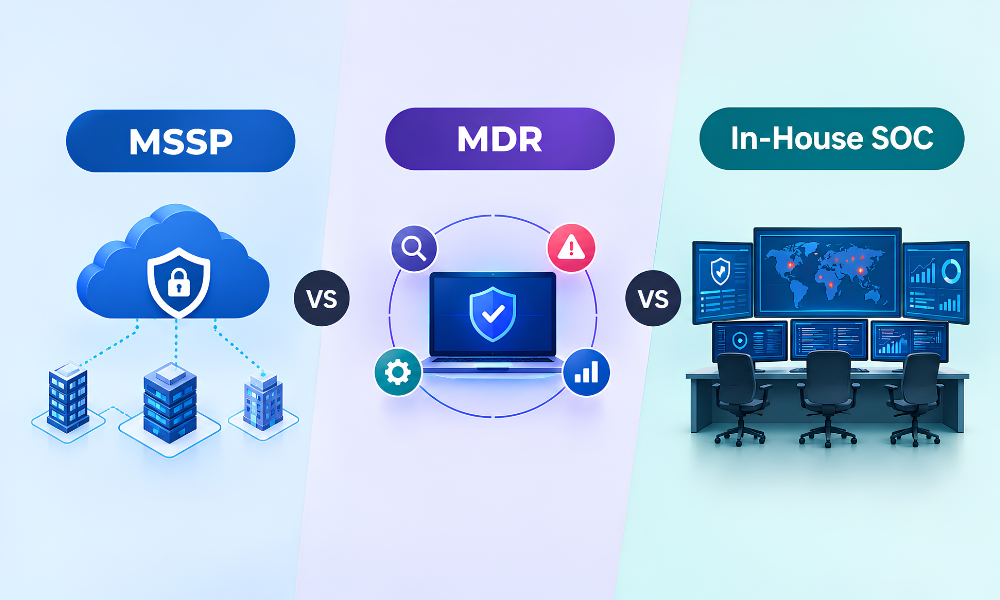
An MSSP (Managed Security Service Provider) typically manages and monitors security technologies such as firewalls, SIEM platforms, endpoints, and network security controls. Its primary responsibility is maintaining visibility into the organization's security environment.
MDR (Managed Detection and Response) goes a step further by combining security technology with human expertise to detect and investigate suspicious activity, hunt for threats, prioritize and investigate alerts, and respond to confirmed or suspected security incidents.
An in-house SOC (Security Operations Center) puts security operations directly under the organization's control. The organization's own security analysts and other security personnel manage activities such as security monitoring, detection, investigation, threat hunting, and incident response.
MSSPs mainly monitor and manage security infrastructure, while MDR providers prioritize threat detection and response. An in-house SOC gives organizations full control over their security operations.
MSSP vs MDR vs In-House SOC: A Side-by-Side Quick Comparison
Criteria |
MSSP |
MDR |
In-House SOC |
| Primary Focus | Security monitoring and management | Threat detection, investigation, and response | Complete security operations management |
| Managed By | External provider | External provider with security experts | Internal security team |
| Threat Detection | Basic to advanced | Advanced | Depends on team capabilities |
| Incident Response | Limited or guided | Active response support | Fully managed internally |
| Internal Staffing Required | Low | Low to moderate | High |
| Deployment speed | Fast | Fast | Slow |
| Cost | Moderate | Moderate to high | High |
| Best For | Organizations needing outsourced monitoring | Organizations needing expert threat response | Organizations requiring full control |
When Is an MSSP the Right Choice?
Many organizations turn to an MSSP when they need better visibility but lack the resources to build their own security team.
An MSSP helps monitor security tools and alerts. It also provides ongoing support for critical systems. This makes it easier for companies to manage alert overload and improve efficiency.
One of the biggest advantages of an MSSP is that it enables continuous monitoring without requiring large-scale recruitment. Organizations can access skilled security professionals without the high cost of building an internal SOC.
However, businesses evaluating MSSP vs MDR should remember that monitoring does not always include active response. An MSSP may identify suspicious activity and notify the customer, but the organization often needs to fix the security issues itself.
Why Organizations Choose MDR (Managed Detection and Response)
Modern cyberattacks are often difficult to detect early. Attackers frequently move silently through networks. They can stay hidden for a long time while gaining access. Traditional security tools may not detect them until they trigger an alert.
This is where Managed Detection and Response becomes valuable. MDR providers focus on detecting actual security threats. Many MDR providers use frameworks such as MITRE ATT&CK to identify suspicious behavior and accelerate incident response. They review alerts to confirm threats, take action when they detect malicious activity, and reduce unnecessary security alerts while helping teams focus on important issues.
For organizations comparing MDR vs SOC, MDR gives them access to skilled security experts without hiring a full internal team. This makes MDR a strong choice for enterprises facing security risks but having limited cybersecurity resources.
The trade off is that organizations share some operational control with the provider. So choosing a trusted vendor matters.
Why Some Organizations Build Their Own Security Operations Center
For some organizations, outsourcing modern security functions may not be feasible. Large enterprises, government agencies, or financial institutions often need direct control over their security processes. Only an in-house Security Operations Center (SOC) can provide this level of control. It allows more customization and direct management than external services.
With SOC teams, organizations can create their own threat detection rules. They can also design investigation and reporting processes. They can also tailor incident response procedures. Many SOC teams use the NIST Cybersecurity Framework to improve their security processes and governance.
The main challenge is long-term sustainability. Recruiting, training, and retaining qualified security professionals remains difficult. Providing 24/7 security coverage requires more investment in technology, teams, and operational processes.
Why More Organizations Are Adopting Hybrid Models
Many organizations are combining different security approaches. A hybrid approach combines internal expertise with external support.
For example, a company can manage its security strategy internally and use MDR for 24/7 monitoring and incident response. This model lets organizations keep control of their security while getting help from experienced security professionals.
Hybrid security operations are becoming increasingly popular as organizations look to balance internal visibility with external expertise while controlling costs.
How to Choose Between MSSP, MDR, and an In-House SOC
The best security model depends on your organization's specific needs.
If your goal is reliable security monitoring with minimal staffing requirements, an MSSP may be the most practical solution.
If you need modern threat detection and response capabilities without building a large internal team, MDR often delivers the strongest value.
If your organization requires complete ownership of cybersecurity operations, an internal Security Operations Center may be worth the investment.
Focus less on finding the best model and more on choosing one that fits your risks, team skills, compliance needs, and goals.
The Bottom Line:
The debate around MSSP vs MDR vs In-House SOC is ultimately about finding the right balance of expertise, control, and efficiency. An MSSP helps organizations strengthen security monitoring, MDR enhances threat detection and response, and an In-House SOC delivers the highest level of control and customization. The right approach depends on your organization's needs. Your security program should be flexible and help you detect threats quickly. It should also help you respond with confidence and build a strong security program against the modern threat landscape.
For more such information visit our official website now!
Frequently Asked Questions
1. What is the difference between MSSP, MDR, and an In-House SOC?
Answer: An MSSP focuses on security monitoring, MDR specializes in threat detection and response, and an In-House SOC manages all security operations internally.
2. Can an MSSP provide MDR services?
Answer: Yes. Many modern MSSPs offer MDR capabilities as part of their service portfolio. However, the level of investigation can vary significantly between providers.
3. What is SOC as a Service (SOCaaS)?
Answer: SOCaaS is an outsourced security operations model that provides monitoring and security management without building an internal SOC.
Recommended For You: