

Modern businesses use hundreds of software apps to run daily operations and fuel business growth. Yet handling this expanding technology landscape is increasingly tough. WalkMe's State of Digital Adoption 2025 reports that enterprises use an average of 625 applications, including 172 AI-powered applications, even though they estimate they use only 37. This wide gap highlights a major challenge: organizations cannot optimize applications they cannot properly identify.
That is why Application Portfolio Management (APM) matters. It gives enterprises clear visibility into their software ecosystem. It also helps enterprises control IT costs and ensure every tool supports a clear business goal.
What Is Application Portfolio Management?
Application Portfolio Management (APM) is a structured approach for tracking and optimizing every software tool across an enterprise.
It provides a centralized view of an enterprise's applications' business purpose and total operating cost. It also tracks technical health, security risks, and system connections.
Rather than managing applications individually, APM evaluates the entire portfolio. It determines which applications to retain, upgrade, consolidate, replace, or retire.
For modern enterprises, this creates a stronger connection between IT investments and business priorities. It also supports better technology decisions by helping leadership understand the actual value and cost of their application ecosystem.
The Major Risks of Skipping Application Portfolio Management
Growing businesses often end up with more complex technology environments when departments purchase software without central oversight.
Without effective application portfolio management, this creates several costly challenges.
- Rising IT costs: Organizations waste budget on unused licenses and unnecessary maintenance.
- Application sprawl: Operations slow down when different teams use separate software for the same task.
- Security vulnerabilities: Relying on outdated technology and unsupported software exposes the business to cyber threats and compliance gaps.
- Integration challenges: Sharing data and maintaining smooth workflows becomes difficult when tools cannot connect.
- Technical debt: Legacy systems require extra and heavy maintenance and limit adoption of modern tools and technologies.
Key Components of Application Portfolio Management
A strong APM strategy brings together five core pillars to keep your software environment healthy and aligned with business goals.
1. Application Inventory and Discovery
The first pillar is building a complete record of every application used across the enterprise. This includes cloud platforms and SaaS products, as well as internally built software and legacy systems.
Enterprises should document key details like ownership and costs, as well as user counts and system dependencies. Automated discovery tools can improve accuracy and reveal applications that traditional IT records overlook.
2. Business Value Assessment
Some apps generate revenue every day, while others barely get used. Teams need to measure each app by tracking active employee logins and checking how much core operations depend on it.
3. Technical Health and Risk Assessment
Software that performs well today might still struggle tomorrow. Take a close look at each tool's age, security gaps, vendor support, and maintainability. Measuring these technical factors against business value helps teams avoid turning off vital legacy tools prematurely just because their code is outdated.
4. Application Rationalization
Rationalization is the decision-making pillar focused on eliminating excess tools. It targets overlapping software so teams can merge duplicate systems and cancel unused licenses.
5. Lifecycle and Governance Management
Managing software is an ongoing discipline rather than a one-time cleanup project. Assigning clear owners and enforcing strict purchasing rules keeps your tech stack under control as the company grows.
The Application Portfolio Management Process
A clear step-by-step plan turns raw software lists into real cost savings and better performance.
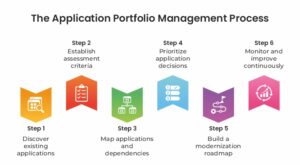
Step 1: Discover existing applications
Pull together a central inventory using IT asset logs and CMDB data. Also cross-check cloud billing dashboards, procurement records, and stakeholder interviews.
Step 2: Establish assessment criteria
Define a consistent scoring matrix before evaluating individual apps. Make sure to include operating costs alongside security and strategic fit.
Step 3: Map applications and dependencies
Understand how applications support daily workflows and interact with other connected systems. Mapping these links prevents future updates from accidentally breaking critical operations.
Step 4: Prioritize application decisions
Using proven frameworks like Gartner's application rationalization model, sort your scored software into five practical action groups:
- Retain: Keep applications that deliver strong results and run smoothly.
- Modernize: Upgrade valuable applications that need technical improvements.
- Consolidate: Merge applications with overlapping functionality.
- Replace: Swap out tools that no longer meet business or technical needs.
- Retire: Applications that provide little value or are no longer needed.
Step 5: Build a modernization roadmap
Schedule your updates based on implementation effort and expected payoff. Assign clear owners and measurable targets to every project.
Step 6: Monitor and improve continuously
Track active user adoption and live system performance regularly. Adjust your roadmap whenever business priorities or technology conditions shift.
Application Portfolio Management Best Practices
Maintaining a healthy software ecosystem requires strong governance habits alongside your core APM workflow. Enterprises should adopt these essential practices to maximize long-term results:
- Align business and technical stakeholders: Bring application owners and enterprise architects together with finance and security teams before making major portfolio decisions.
- Connect live data sources: Sync your APM platform directly with IT asset management and SaaS discovery feeds so your records stay accurate automatically.
- Govern AI-powered applications: Track generative AI tools alongside their business owners and data access permissions to prevent security leaks.
- Standardize scoring across departments: Apply the same evaluation framework across all departments to ensure fair, objective decisions.
- Assign clear business ownership: Require every new software purchase to have an accountable owner before budget approval.
A critical rule is that application rationalization should never focus solely on cutting app counts. Removing a seemingly low-value tool without mapping its data dependencies can trigger higher costs and severe operational disruptions.
How to Measure Application Portfolio Management Success
Enterprises should evaluate APM through measurable business and technical outcomes. Tracking the right metrics shows whether portfolio changes reduce waste and improve system reliability.
Useful key performance indicators include:
- Total cost of application ownership: Measures the complete expense of licensing and maintaining each application.
- Number of redundant or unused applications: Tracks how many duplicate tools have been consolidated or retired.
- Software license utilization: Compares paid seats against active daily users to uncover wasted spend.
- Ownership coverage: Shows the percentage of business-critical applications with an assigned owner.
- Unsupported application count: Identifies legacy systems running without active vendor security patches.
- Application availability and speed: Monitors uptime and technical performance across core workflows.
- Technical debt reduction: Tracks progress in modernizing outdated code and retiring aging infrastructure.
Regularly reviewing these metrics helps CIOs and IT leaders prove that portfolio improvements deliver real business value.
Conclusion
Software should make your business faster, not hold it back. Without a clear plan, your tools can rapidly turn into a source of confusion and wasted budget.
Application Portfolio Management shifts your team from reacting to tech problems to making smart, planned choices. You do not need to fix everything overnight. Start by getting a clear view of what you have today, and build a stronger, simpler software setup one step at a time.
Everything you need to know is waiting on our official website.
FAQs
What is the difference between application rationalization and APM?
Answer: Application Portfolio Management (APM) is the ongoing, day-to-day tracking of all your company's software. In contrast, application rationalization is the periodic cleanup project used to cut costs and remove duplicate or outdated apps.
Can APM support digital transformation?
Answer: Yes, Application Portfolio Management (APM) is a key driver for successful digital transformation. It gives leaders clear visibility into their existing software so they can retire outdated
Read More: