Google makes everyday coding and agentic workflows faster and more efficient with the introduction of Gemini 4 Hydrogen. Released on November 12, 2026, the model helps in executing tasks faster across software development and agentic workflows, making multi-model collaboration more efficient.
The launch of Hydrogen follows the introduction of Gemini 4 Argon and Carbon, which addressed complex reasoning tasks. However, the new model prioritizes speed and efficient execution of tasks, while adding higher intelligence. According to Google, the model can complete tasks 2.5 times faster than Gemini 3.8 Flash at its default high thinking level.
Hydrogen is rolling out across consumer, developer, and enterprise platforms, including the Gemini app, Google Search, Gemini API, and Google AI Studio.
Coding and Multimodal Workflows Observe Major Improvements
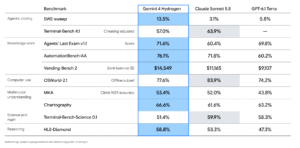
Gemini 4 Hydrogen reflects remarkable improvements for developers working on large software projects, supporting repository coding, debugging, codebase navigation, and interactive web development. Google reported a Terminal-Bench 4.1 score of 57% for Hydrogen, which shows a noticeable enhancement compared to Gemini 3.8 Flash's 18.2%. According to Google's evaluations, the model also reduces fabricated claims by more than five times.
Below is a glimpse of Gemini 4 Hydrogen's performance across different benchmarks used to assess diverse capabilities, including coding, knowledge work, reasoning, multimodal understanding, and others-
The new model's multimodal capabilities go beyond conventional coding tasks with the ability to process PDFs, spreadsheets, charts, audio, and recorded videos. Developers can use these capabilities to generate structured reports and handle complex information.
Apart from these, Google has also highlighted improvements in data-heavy enterprise workflows in Hydrogen. Its early testing partners reported processing speeds between two and 2.8 times faster. In this regard, token consumption also decreased by 12% to 23% compared with Gemini 3.8 Flash.
These improvements can be highly beneficial for teams handling research, financial analysis, and large code repositories.
Multi-Model Collaboration Becomes More Efficient
Alongside Gemini 4 Hydrogen, Google launched Orchestrator in Google Antigravity, which enables different Gemini models to collaborate within a single workflow. Orchestrator can switch between models based on task requirements instead of relying on one model throughout a project. With the feature, Gemini 4 Carbon can handle complex planning and coordination while Hydrogen can manage coding, testing, and verification.
Orchestrator attained near-Carbon task success rates while consuming 24% less quota and completing tasks 19% faster on average in Google's Terminal-Bench 4.0 evaluation. The platform can also deploy parallel agents across isolated workspaces, allowing multiple agents to build and test different components simultaneously.
Google's Safety Considerations
Google has improved its safety and security approaches while introducing Gemini 4 Hydrogen. These include protections against misuse alongside risks associated with agentic workflows.
Nevertheless, the model has major limitations that users must know about. Google warns that Hydrogen can hallucinate and produce biased outputs even after attaining noticeable performance across benchmarks. Its model card also observes occasional slowdowns and timeouts, which can create disruption for users. Additionally, the documented knowledge cutoff of the model is March 2026.
Availability and Pricing of Gemini 4 Hydrogen
Gemini 4 Hydrogen is now available globally across Google's consumer, developer, and enterprise offerings. Developers can access the model through the Gemini API, Google AI Studio, and Android Studio. Paid Google AI Pro and Ultra subscribers can also use it through Google Antigravity.
Enterprises can use Hydrogen through Gemini for business and eligible Google Sheets subscriptions. Additionally, consumers can use the model through Google Search and the Gemini app. Notably, access to the model varies by consumer subscription. Apart from that, free Gemini app users receive Hydrogen through automatic model selection, as the app selects it when the model suits their prompts.
Gemini 4 Hydrogen costs $1.50 per million input tokens, and output tokens cost $7.50 per million. The pricing remains consistent across its supported context window.
Want to learn about the latest AI models and developments? KnowledgeNile is your one-stop destination for all major AI updates and tech breakthroughs.
Recommended For You:
Google’s New Gemini 4 Carbon to Unlock Advanced Cybersecurity and Long Horizon Capabilities