Google advances cybersecurity, software engineering, and complex, long-running AI tasks with the announcement of Gemini 4 Carbon. Launched on October 28, 2026, Google describes the model as its strongest model yet, with improved capabilities for detecting vulnerabilities and developing software fixes.
Initial access to the 'state-of-the-art cybersecurity and long horizon' model will remain limited to selected cybersecurity defenders through Google's Fairwind Program. However, its expanded access plan will gradually be executed with the continuous evaluation of the model's safeguards.
Notably, Google introduced the latest model just after the launch of Gemini 4 Argon, which addresses deep work and real-world tasks across coding, finance, cybersecurity, legal, and science. The back-to-back model launch intensifies competition among AI developers seeking advances in coding, autonomous workflows, and cybersecurity defense.
Gemini 4 Carbon Reports Remarkable Performance Across Cybersecurity Benchmarks:
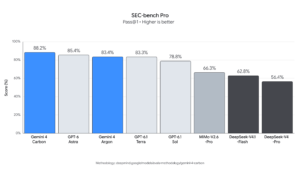
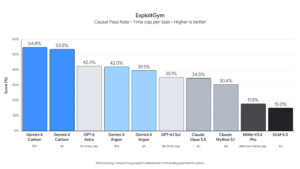
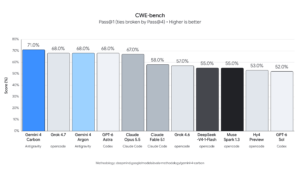
Google highlighted three external benchmarks to describe Carbon's cybersecurity capabilities, covering vulnerability discovery, exploit validation, and software remediation. The model achieved an 88.2% score on SEC-bench Pro, which evaluates its ability to identify vulnerabilities. Apart from that, it scored 54.8% on ExploitGym, a benchmark for validating vulnerabilities through exploitation. On CWE-bench, Carbon achieved 71.0% for addressing underlying software weaknesses.
Addresses Complex, Long-Running Engineering Tasks:
Gemini 4 Carbon addresses engineering problems that require sustained reasoning across multiple steps, apart from focusing on cybersecurity. Google's internal teams observed the model working for days on challenging assignments, including tracing subtle bugs across large codebases and low-level systems. The model aims to continue working through setbacks rather than abandoning complicated problems prematurely.
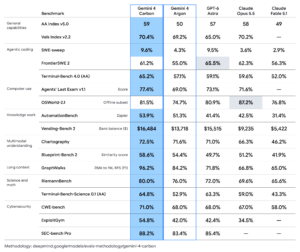
Google also reported improvements in coding, scientific tasks, agentic workflows, and multimodal understanding. In web development, Carbon gained 89 Elo points on WebDev Arena, reaching fourth place with a score of 1,768. These capabilities are set to help developers investigate difficult software issues and complete extended engineering workflows.
Here is a depiction of Gemini 4 Carbon's performance across general capabilities, agentic coding, computer use, and other benchmarks:
Google Prioritizes Safety Measures in Gemini 4 Carbon:
Google is taking a cautious approach while rolling out Carbon, as advanced AI capabilities can create cybersecurity risks. The company is participating in the US government's voluntary pre-release model testing process. Carbon builds on Argon's safety framework, which combines model training, real-time misuse defenses, prompt-injection resistance, and chain-of-thought monitoring.
Availability and Pricing:
Gemini 4 Carbon will initially be available for a subset of cybersecurity defenders through Google's Fairwind Program. Additional trusted partners will receive access gradually. Google has not yet announced a specific date for broader availability to developers, businesses, and consumers.
The model's introductory API pricing matches Gemini 4 Argon's rates. Input costs $2 per million tokens, while output costs $10 per million tokens. Cached input tokens receive a 95% discount against the input token price. After the introductory period, pricing will increase to $4 per million input tokens and $20 per million output tokens. Google has not specified when the introductory period will end.
Browse our news section and stay aligned with the newest AI developments and industry breakthroughs.
Recommended For You:
Google Introduces Its Latest Models, Gemini 3.8 Flash and 3.8 Flash Cyber
Google is Bringing Gemini Personal Intelligence to Android Auto Globally
ChatGPT vs Claude vs Gemini: Which AI Is Best for Everyday Tasks?