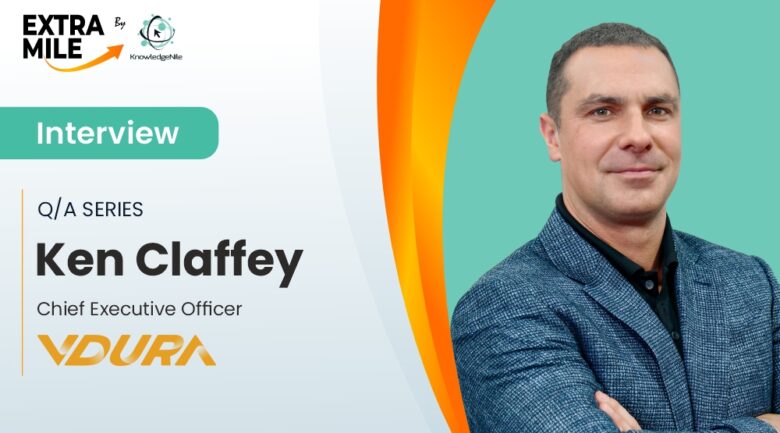
Presenting the latest ExtraMile by KnowledgeNile conversation, highlighting C-suite leaders, innovators, and senior technologists who share frontline insights into today's tech megatrends and developments.
This session is impactful, as we dive into the world of data storage infrastructure with none other than the Chief Executive Officer of VDURA Ken Claffey. VDURA provides high-performance data storage infrastructure for AI factories and Neoclouds, powered by its HYDRA software-defined architecture.
Our featured guest, Ken, has a track record of building and scaling businesses across the HPC and storage ecosystem. As CEO of VDURA, Ken brings the strategic insight and hands-on expertise to translate vision into results.
In this conversation, Ken shares his insights on the transformation of HPC, storage, and enterprise infrastructure. He also talks about the changing GTM landscape, the needs of AI factories and Neoclouds, the importance of customer feedback, VDURA's HYDRA architecture, and the future of AI infrastructure.
So, don't miss out on gaining insights from today's top voice of the industry! Let's dive in...
Having worked extensively across HPC, big data, cloud systems, and enterprise infrastructure, what are some of the major transformations you have observed across these technologies throughout your career?
Ken. The constant across every era has been the same tension: compute gets faster, and the infrastructure around it has to catch up. At Xyratex we built the first purpose-built HPC storage appliance because nothing off the shelf could feed a supercomputer, and that system went on to power roughly 40% of the world's top machines. At Seagate the problem moved to cloud scale, where durability and economics mattered as much as speed. AI is the same pattern at a different order of magnitude, with one important difference. The GPU is not just a scarce resource, it is a revenue-generating asset. An AI factory or a neocloud sells GPU hours. Every minute a GPU waits on a checkpoint, a model load, or a cold read is inventory that expires unsold, and every inference session that has to recompute its context from scratch is GPU time spent producing the same tokens twice. Storage used to be a cost center that sat behind compute. In this era it is the thing that determines how much of your GPU capacity turns into billable output, and the market is catching up to that reality.
You're ace at creating new GTM motions. What are the signs that indicate that the current GTM strategy needs to change? Could you highlight a few points in this regard?
Ken. The first sign is when the conversations you are having with buyers no longer match the conversations your materials were built for. Two years ago the buyer question was "how many GPUs can I get." Today it is "how do I get more revenue out of the GPUs I have, and how do I add the next thousand without adding a second storage team." If your motion is still pitching capacity and feature lists, you are talking past the person who signs. The second sign is where pipeline velocity moves. When a motion stalls in one segment and accelerates in another, the market is telling you where to point resources. For us that was Neoclouds and AI factories. The third is when your best proof points are about you rather than about the customer's business. We are in the middle of that shift at VDURA: moving our focus to conversations about the operator's P&L, revenue per GPU, margin per tenant, and how many more GPUs a given power and rack budget can support when storage stops consuming it.
What untapped market gap did you see that allowed the development and growth of VDURA? How is the company addressing this gap?
Ken. The gap was that GPU clouds were being built with storage designed for a single enterprise, not for a business that sells infrastructure to many customers at once. A neocloud has to isolate tenants, provision through APIs, meet SLAs it is contractually liable for, and do all of that while keeping thousands of accelerators saturated across very different workloads. Training wants sustained parallel reads. Checkpointing wants bursts of writes that land in minutes, not hours. Inference wants first-token latency and as many concurrent users per GPU as possible. Nobody had built a data platform around that operating model. VDURA's HYDRA architecture is our answer: one software stack that serves all three workloads, with per-tenant quality of service, encryption keys and network isolation, and an API-first control plane so storage rolls out the way the rest of the cloud does. The market gap was a storage platform an operator could build a business on.
From your perspective, what role do customer feedback and real-world workloads play in framing VDURA's product roadmap?
Ken. It is the single biggest input we have, and it comes from watching production GPU clusters. Three examples from the last year. Operators told us checkpoint windows were eating training time, so we built RDMA data paths that move data GPU-to-storage with the CPU out of the loop, and a client that takes about 191 MB of memory and zero cores from the GPU node. They told us inference sessions were re-computing context every time a pod restarted, so we are delivering KV cache that outlives the pod. And they told us data placement was a full-time job, so Context-Aware Tiering moves data automatically as it warms or cools between training and inference. We heard this directly from the customers and that’s what we have been building.
As AI infrastructure costs are rising, mainly due to NAND and flash price volatility, how should organizations approach their storage strategy to control costs without compromising performance?
Ken. I would reframe the question. The goal is not to control storage cost, it is to maximize what the GPU fleet earns, and storage is the biggest lever most operators have not pulled. Flash is a performance medium, not a capacity medium. The hyperscalers figured this out: just enough flash to saturate the GPUs, high-density disk for everything else, and software that moves data between them automatically. When you build that way, roughly 90% of files stay on flash and roughly 90% of capacity settles on disk, in one platform, with no stub files and no manual tuning. The payoff shows up in two places on the operator's P&L. Power and rack space that used to go to storage go to GPUs instead. Capital that used to buy flash for cold data buys accelerators. Size the platform against the workloads you actually run, checkpointing, inference and training, and the capital you free up buys more GPUs.
What makes VDURA's approach to data storage stand out from traditional enterprise storage architectures? How does the HYDRA architecture help organizations achieve GPU utilization while keeping costs down?
Ken. Traditional enterprise storage was built around specialized hardware: HA pairs, RAID controllers, dual-ported drives, gateway tiers in the data path. That model breaks at AI scale, where you need linear performance across a thousand nodes and the failure domain of one appliance can idle a whole cluster. HYDRA, our High-Performance, Yield-Optimized, Distributed, Resilient Architecture, is shared-nothing and software-defined. Every GPU node talks to every storage node in parallel. Availability and fault tolerance live in software, so failure domains are as small as a single virtual pool, rebuilds are automatic, and there are no downtime windows. Metadata scales elastically, which is what lets checkpointing and inference run on the same system without one starving the other. For the operator, the result is more than 2x the performance per watt and more than 60% lower total cost than competitive architectures at the same feed rate, which translates directly into more GPUs per rack, higher margin per tenant, and SLAs backed by six nines of availability. And because HYDRA runs on commodity servers and media from multiple certified vendors, a single supply constrain doesn’t stop an expansion.
Congratulations to VDURA for being on the list of finalists for the CRN 2026 Tech Innovator Awards. What does this milestone mean for the company?
Ken. Thank you. Recognition from CRN matters because it comes from editors evaluating us against the entire storage field on capability, uniqueness and ingenuity, not from our own narrative. It also matters because of who reads CRN. The partners who build and operate AI factories and GPU clouds are the ones deciding which storage platform goes into the next rack, and they need to trust that the platform will still be standing in year seven of a ten-year infrastructure life. For a company that has transformed from Panasas into a software-defined AI platform, recognition like this is a marker that the reinvention is landing with the people who put our platform in front of customers every day.
What's your take on the future of enterprise technology and data infrastructure? How do you see AI, cloud, storage, and data management reshaping enterprise IT strategies?
Ken. Three shifts. First, the center of gravity moves from training to inference, and inference is a very different storage problem. Training is a handful of enormous jobs. Inference is millions of sessions, each with context that is expensive to rebuild. Persistent context, a KV cache that survives across pods and sessions, becomes core infrastructure, because it is the difference between serving more users on the same GPUs and buying more GPUs to serve the same users. Second, storage becomes a service the operator sells, not a component the operator buys. Multi-tenancy, per-tenant SLAs and API-driven provisioning stop being enterprise features and become the product. Third, infrastructure that is locked to specific hardware or a single media type will lose to infrastructure that can adapt as workloads and component pricing shift. The winners in the next phase will be the AI factories and Neoclouds that treat the data layer as a margin lever, not a line item, and the enterprises that buy from them will get better economics as a result.
Tune Into Our Other Informative Interviews:
How Magnetto is Scaling Global Brand Growth through Telegram Advertising Ft. Alex Malgin, CEO