
Google has announced three new AI models, Gemini 3.6 Flash, 3.5 Flash-Lite, and 3.5 Flash Cyber, to help developers and customers build faster, reliable, and efficient AI agents at scale. The announcement focuses on improving token efficiency, reducing latency, enhancing coding, and strengthening cybersecurity applications.
These models are built upon Gemini 3.5 Flash and are designed to support production-grade AI workflows across document analysis, enterprise automation, and broader agentic use cases.
Gemini 3.6 Flash: Google's New AI Workhorse
Gemini 3.6 Flash is positioned as Google's new AI workhorse model designed for coding and knowledge work with improved token efficiency. The model is built on feedback from developers and users of 3.5 Flash. Compared to Gemini 3.5 Flash, it consumes 17% fewer output tokens and requires fewer reasoning steps and tools to complete a multi-step task.
Pricing:
- $1.50 per million input tokens.
- $7.50 per million output tokens.
Google claims the model shows improved performance across several industry benchmarks, excelling at better code generation, machine learning research, computer use tasks, and knowledge work. It also sees performance gains compared to 3.5 Flash across several use cases.
| Benchmark | Gemini 3.6 Flash | Gemini 3.5 Flash |
| DeepSWE | 49% | 37% |
| MLE Bench | 63.9% | 49.7% |
| OSWorld-Verified | 83.0% | 78.4% |
| GDPval-AA v2 | 1421 | 1349 |
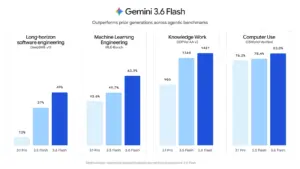
Gemini 3.6 Flash delivers higher precision with fewer unwanted code edits and reduced execution loops, as seen in its DeepSWE performance. Computer use is now a built-in client-side tool via the Gemini API and Gemini Enterprise. Alongside, customers like Hebbia and Harvey are already using the model for multimodal tasks such as document parsing, chart and data analysis, and report drafting.
Gemini 3.5 Flash-Lite: Excels at Speed and Scale
Google has also released Gemini 3.5 Flash-Lite, its fastest model in the Gemini 3.5 family. The model is built for low-latency, and high-throughput workloads such as agentic search and document processing.
Flash-Lite runs at 350 output tokens per second as calculated by Artificial Analysis. Developers can choose different reasoning levels based on whether they prioritize low-latency, low-cost execution, or engage in higher thinking levels to process multi-step subagent workloads.
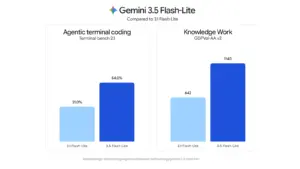
Google says the model outperforms Gemini 3.1 Flash-Lite across thinking levels and even surpasses Gemini 3 Flash in several coding and agentic benchmarks while maintaining lower operational costs.
| Benchmark | Gemini 3.5 Flash-Lite | Gemini 3 Flash |
| Terminal-Bench 2.1 | 54% | 31% |
| GDM-MRCR V2 | 72.2% | 60.1% |
| GDPval-AA v2 | 1140 | 642 |
| SWE-Bench Pro | 54.2% | 49.6% |
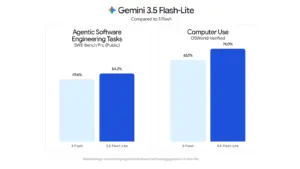
The model is priced at $0.3/1M input tokens and $2.5/1M output tokens with a strong price-to-performance ratio for developers and organizations with high-volume traffic.
Gemini 3.5 Flash Cyber: Strengthening Cybersecurity with AI
For cybersecurity purposes, Google has introduced Gemini 3.5 Flash Cyber, a specialized model integrated with the CodeMender security platform.
The model is built on top of 3.5 Flash and is designed to find and fix cybersecurity vulnerabilities at a lower price per token than larger models. According to Google's announcement, "3.5 Flash Cyber reaches competitive performance at the frontier on the popular benchmark CyberGym."
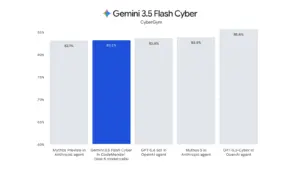
Due to the sensitive nature of offensive cybersecurity capabilities, the model will initially be available to governments and trusted partners via CodeMender, through a limited-access pilot program.
Google has strengthened safety across its latest models. Gemini 3.6 Flash includes enhanced Frontier Safety protection in various domains, including chemical, biological, radiological, and nuclear (CBRN) and cyber offense misuses. The company claims these safeguards make the model more resistant to jailbreak attempts without compromising productivity for developers and enterprises.
Availability and What's Next?
The new models 3.6 Flash and 3.5 Flash-Lite are available through:
- For developers: The 3.6 Flash model is available in the Gemini API via Google AI Studio and Android Studio.
- For enterprises: Within the Gemini Enterprise Agent Platform, 3.6 Flash is available in the Gemini Enterprise app.
- For general users: The 3.5 Flash-Lite is rolling out in Google Search.
Gemini 3.5 Pro is currently being tested, with plans for a broader release ahead. The new updates mark Google’s significant step in advancing AI capabilities to the next level.
Stay aligned with all the trending news around the tech landscape; head over to our website now.
Recommended For You:
Google Brings Personal Intelligence to All US Users Across AI Mode, Gemini App, and Chrome