
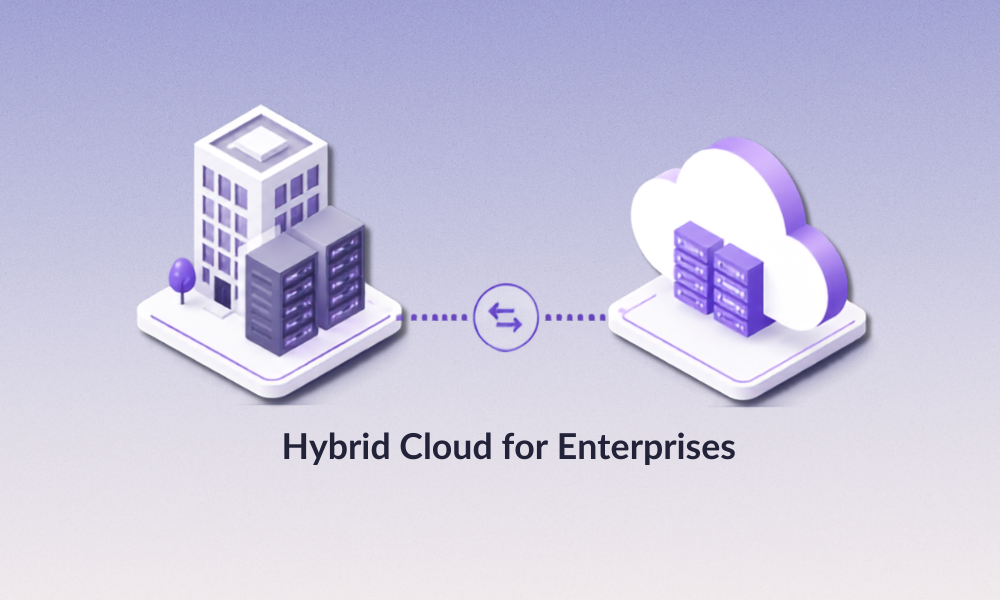
Every organization has unique cloud model requirements. Hybrid cloud for enterprises enables organizations to customize their IT frameworks to meet these requirements by combining public and private clouds with existing infrastructure.
Hybrid cloud is not only an innovative computing solution, but it also helps protect your enterprise's confidential data while reducing operational costs.
Let's drill down into hybrid cloud for enterprises. By the end of this blog, you'll gain a full understanding of what this technology is, how it works, its main components, advantages and disadvantages, and use cases.
Understanding Enterprise Hybrid Cloud
Hybrid Cloud for enterprises is a technological architecture that integrates an organization's private infrastructure, including on-premises data centers or private clouds, with public cloud services.
Hence, a hybrid cloud structure enables:
- Robust security and compliance for sensitive enterprise data.
- The smooth running of workloads on public clouds.
- Merging the strengths of both private and public environments to form a single operating model.
How Does It Work?
A hybrid cloud infrastructure combines a company's on-premises systems and computers with public cloud services. These two environments share data and workloads. Hence, the work is managed between public cloud providers and the company's IT team.
This team oversees data center operations, power, cooling, and maintenance of local equipment. Whereas the public cloud provider oversees the hardware and software being used, and the updates and maintenance of the infrastructure. Public cloud management depends on the type of cloud service being used, such as IaaS, SaaS, PaaS, etc.
IT teams can monitor and manage the entire hybrid environment using a single management software. However, IT personnel still use the public cloud provider's tools to resolve issues across the hybrid cloud.
Key Components of Hybrid Cloud Infrastructures in Enterprises
An enterprise hybrid cloud architecture would not work without the seamless coordination of the following technologies:
- Private Cloud: A private cloud, which includes on-premises infrastructure, lets organizations retain control over their sensitive data and critical business applications. This is important for companies that must follow strict regulations because it helps them maintain security and compliance.
- Public Cloud: Public cloud is typically managed by the cloud service provider, so companies must give up some control over the infrastructure. As a solution, companies can use Virtual Private Clouds (VPCs). These provide an isolated unit within the public cloud, giving companies more control over their resources, operations, and security.
- Management Platform: When multiple environments work together as a single system, like in a hybrid cloud for enterprises, it can become difficult to manage all of them. Hence, management platforms act as a single point of reference for all processes, including automation, monitoring, and policy enforcement.
- Connectivity: The public cloud can be connected to the private cloud through direct network cables, VPNs, iSCSI network adapters, etc. These channels enable the efficient flow of workloads without compromising security and performance.
Advantages of Using Hybrid Cloud Services in Enterprises
- Business Continuity: A hybrid cloud helps with disaster recovery by storing backup data both locally and in the cloud. This reduces the risk of data loss and allows faster recovery because data is regularly copied and updated. This enables business continuity and ensures the data is accurate and reliable.
- Flexibility: Organizations use a hybrid cloud model because it provides more control and flexibility over data and where applications are stored. A company’s sensitive data can be kept in a private cloud for better security, while less sensitive workloads can be processed in the public cloud.
- Compliance: A hybrid cloud helps organizations meet regulations by allowing them to control where data is stored, how it is copied, and how it is protected through encryption. This makes it easier to follow privacy and security rules in different countries.
- Better Security: Hybrid cloud for enterprises improves security by allowing sensitive data and critical applications to stay in private environments. Less sensitive workloads can be processed in the public cloud. This helps organizations secure sensitive data, meet regulatory requirements, and maintain control over data access.
- Improved Scalability: Enterprise hybrid cloud combines the public cloud's limitless on-demand computing power with the control of on-premises private infrastructure. This lets organizations increase scalability while meeting resource requirements without delays caused by purchasing and installation processes.
- Reduced Costs: Combining private infrastructure with public cloud services enables deploying workloads on the cloud where they perform best. This hybrid cloud feature also helps to reduce IT costs.
Disadvantages of Using Hybrid Cloud Services in Enterprises
- High Initial Setup Costs: Setting up a hybrid cloud can be challenging as it requires significant upfront costs and careful design planning. Organizations should assess their business needs and work with a cloud expert to implement the most suitable hybrid cloud solution.
- Complex Integration: Organizations need to carefully plan before integrating public and private clouds with their systems to ensure a seamless flow of data and processes.
- Visibility: In a hybrid cloud environment, it can be difficult for teams to monitor all systems, applications, and data. This is because all of these are spread across on-premises infrastructure, multiple clouds, SaaS tools, and IoT devices.
- Vendor Dependency: Hybrid cloud environments are dependent on multiple cloud providers and vendors. Organizations are also dependent on SaaS applications, storage devices, and other tools.
- Network Issues: Public clouds may experience latency during peak traffic, which, in turn, may affect on-premises workloads. This can lead to bottlenecks and reduce performance.
- Security Risks: Different policies and regulations across clouds can lead to security risks. Thus, implementing a Zero Trust security model helps unify security requirements across cloud environments.
Enterprise Hybrid Cloud Use Cases
According to reports, the hybrid cloud market is estimated to reach $194.14 billion in 2026, and is projected to reach $347.82 billion by 2031, with a CAGR of 12.37%. But why is the hybrid cloud market expected to grow so much? Let us look at its use cases to find out.
- Cloud Bursting: When demand increases, such as during seasonal sales, an organization can use additional resources from the public cloud to handle the extra workload. This eliminates the need to buy and maintain more on-premises hardware that may only be used occasionally.
- Disaster Recovery and Data Backup: Hybrid cloud for enterprises enables organizations to store their important data on their own servers and keep a backup copy in the cloud. In the event of hardware failures, system crashes, or even natural disasters, organizations can quickly restore their data from the cloud and continue operations with minimal interruption.
- Efficient DevOps Processes: Hybrid clouds work well for organizations that use DevOps practices because teams can easily work across both on-premises systems and public cloud environments. This makes it easier to develop, test, and deploy applications.
Efficient Computing with Enterprise Hybrid Cloud
Hybrid cloud for enterprises leverages the strengths of both public clouds and on-premises private infrastructure to increase computing efficiency. The system is highly scalable and cost-effective for enterprises, as it requires no additional hardware to meet workload requirements. However, the initial integration of the hybrid cloud system with existing infrastructure requires careful planning and may cause systemic issues when overloaded. Enterprises should weigh the pros and cons of this technology before implementing it in their business.
Visit our website, KnowledgeNile, to learn more advanced technologies you can integrate into your business.
FAQs
1. Hybrid cloud architecture works best for which industries?
Answer: A hybrid cloud architecture is best suited for industries such as finance, healthcare, and retail. This is because hybrid cloud solutions protect sensitive data and efficiently handle massive workloads.
2. What are some examples of online services that use hybrid cloud structures?
Answer: Online services like Hulu, Airbnb, and Uber rely on hybrid clouds for data storage.
3. What are some examples of cloud infrastructure providers?
Answer: Amazon Web Services (AWS), Microsoft Azure, and Google Cloud Platform (GCP) are popular global cloud infrastructure providers.
4. What is the difference between hybrid cloud and multi-cloud?
Answer: Hybrid cloud combines an on-premises private cloud with public cloud to create an IT infrastructure. Whereas multi-cloud effectively combines two or more public clouds.
Also Read:
Hybrid Cloud Networking for Workload Portability and Enhanced Security
What is Cloud Modernization? Benefits, Strategies, and Best Practices
How Data Fabric in Multi-Cloud Addresses the Major Setbacks that Businesses Face?