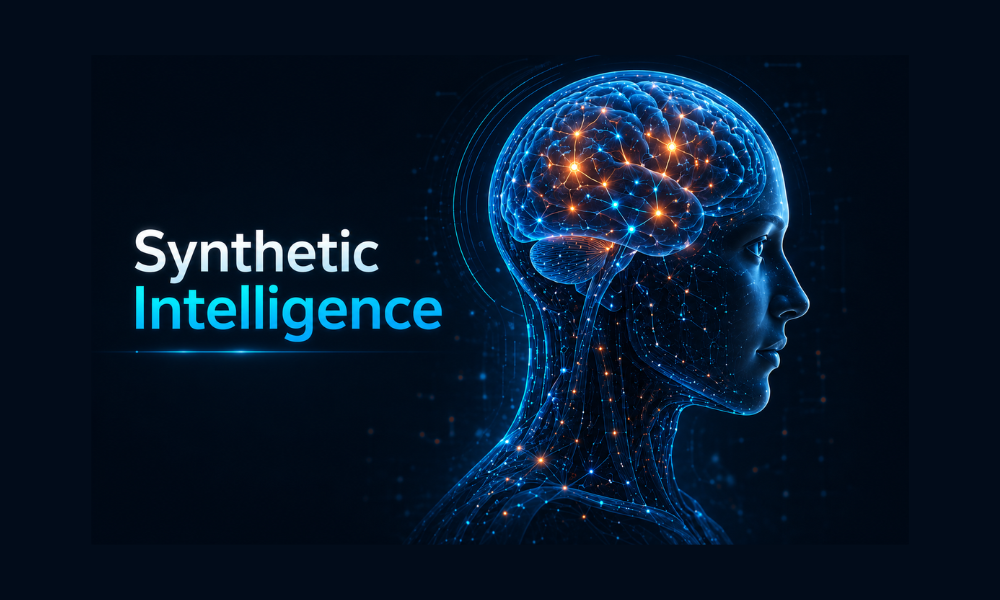
What happens when the tools we built to work for us start thinking just like us? Some will argue that such possibilities are already here with the emergence of AI. But wait! AI just mimics human cognitive processes. On the other hand, synthetic intelligence (SI) creates independent cognitive patterns, just as humans do.
While AI offers simulated intelligence, SI aims to develop genuine, self-originating intelligence, driving meaningful responses to human queries. Unlike AI, which relies on historical data and past use cases, SI derives its abilities from real-time intelligence, observations, and present-time feedback. Though SI has not yet observed an appropriate launch and is still in development, the technology can define the future of diverse industries, including healthcare, finance, robotics, and automation.
So, let us understand SI thoroughly, its challenges, cross-domain use cases, and how it differs from AI. Let’s get started right away...
Understanding Synthetic Intelligence (SI):
Coined originally by John Haugeland in his 1985 book, Artificial Intelligence: The Very Idea, the term, synthetic intelligence (SI) defines intelligence beyond just mimicking human cognition. It rather focuses on creating unique and new intelligence that can evolve with time and operate independently. Such capabilities enable SI to offer effective and unique perspectives to creative tasks, problem-solving, and interactions.
For this purpose, SI combines computation, machine learning, biology, and neuroscience. Hence, with SI, machines can attain significant cognitive abilities without depending on human behavior. Here are the key advantages to know:
- Real-time intelligence: SI aims to emulate biological consciousness by adopting real-time intelligence, continuously assessing the environment, and making instantaneous decisions.
- Zero dependency on historical data: SI goes beyond AI’s ideology of depending on historical data. On the contrary, it constructs intelligence from real-time feedback, observation, and context.
- Continuous learning and improvement: SI systems learn and adapt continuously. This helps the system become more adaptable and flexible while offering meaningful responses.
- Uniqueness in every task and the capability to create: Since SI creates new intelligence, it brings uniqueness to every task. It offers a shift from AI’s monotonousness. Additionally, the technology can generate original thoughts, which enables it to create new solutions, theories, and logic systems.
- Informed decision-making and problem-solving: SI models are capable of making context-aware and informed decisions. With continuous learning, better decision-making, and uniqueness, all together, SI can solve complex and creative problems more efficiently.
Key Concepts and Technologies of SI:
There are a few concepts of synthetic intelligence that will help the system operate independently without depending on the external environment or human cognition.
- Biological-Digital Hybridity: It indicates the amalgamation of computational systems and biological elements, including brain organoids and neuromorphic nanotechnology.
- Self-Awareness: It defines that the SI system recognizes itself as an independent entity. This element helps the technology to understand its internal dynamics, limitations, and makes it capable of understanding what distinguishes it from the external environment.
- Generational Continuity: This concept interprets the system’s capacity to endure over time. It is a continuous process that has to go through changes as well, which the SI system has to learn and adapt to. Generational continuity ensures that the system stays persistent in changing environments.
- Directed Agency: It defines the system’s goal-directed autonomy, which enables it to act with purpose instead of just responding to inputs. This element helps the system to drive its own objectives, make complex decisions, and initiate meaningful actions.
Synthetic intelligence relies on diverse technologies as well to accomplish its goal-
Neural Networks: They help SI systems operate like human brains while learning from real-time data and evolving over time.
Machine Learning and Deep Learning: These technologies assist in processing large amounts of data quickly, making decisions, and solving problems effectively without human surveillance.
Computational Power: SI systems use exceptional computational power to process real-time data, train models, and deploy them while executing complex tasks.
These technologies work together to understand the context and concept instead of just recognizing patterns. As a result, synthetic intelligence can actually learn new things and adapt to changes like living beings. It can additionally make decisions based on genuine reasoning while developing unique forms of intelligence. As the development in the sector continues, researchers can develop further technological integrations to advance SI.
What Challenges Does SI Involve?
Ethical concerns: Since SI develops its own opinion and intelligence without depending on historical data. So, tracking whether such systems are adhering to the ethical guidelines or offering ethical responses can be a huge challenge.
Existential risks: SI systems do not follow human logic and are not confined to dataset boundaries. So, predicting its responses can be challenging, which can lead to bias.
Data privacy: Synthetic intelligence relies on real-time data, feedback, and observation. Data privacy risks can lead to breaches and the exfiltration of sensitive information.
Technological complexity: SI is not just an advanced technology but a significant expansion of AI. Since AI adoption created the challenge of using compatible devices and tools, SI adoption will also create similar difficulties. As a result, mainstream SI adoption may take longer than expected.
Use Cases of Synthetic Intelligence Across Domains:
Scientific Discovery:
SI can develop new physical equations, identify unknown chemical models, and generate new biological theories that advance scientific discovery.
Healthcare:
Synthetic intelligence can enhance personalized healthcare services by analyzing biological states and real-time cellular behavior.
Space Exploration:
SI can assess unknown environments and make real-time decisions, making advancements across deep space, alien planets, and even the multiverse.
Education and Philosophy:
SI can become a personal learning system for students and learners, offering tailored experiences. It can additionally advance philosophical findings with the generation of new intelligence.
Environmental Monitoring:
It can enable cutting-edge climate monitoring, finding and predicting weather patterns, and creating alerts for natural disasters.
Difference Between Artificial Intelligence and Synthetic Intelligence:
Synthetic intelligence is nothing but an expansion of an upgraded version of artificial intelligence. While AI attains intelligence by imitating human cognition, SI drives intelligence through self-origination. Nevertheless, AI is real with a significant adoption rate; SI is still in the development phase with no clear timeline to get officially launched. Here are the other distinctions between AI and SI to learn:
Parameters |
Artificial Intelligence (AI) |
Synthetic Intelligence (SI) |
| Chief goal | Imitate human intelligence and offer responses. | Create fresh cognition and new intelligence that can exceed human abilities. |
| Data used | Historical data, past use cases, and examples. | Real-time cognition, feedback, and autonomous learning loops. |
| Process | Processes historical data while data-driven algorithms track patterns, responding based on stored databases. | Uses self-solving algorithms to initiate independent learning and reasoning. |
| Reasoning | Limited with set rules and data. | Flexible reasoning without limitations of pre-defined guidelines or data. |
| Consciousness | Has no consciousness. | May possibly have awareness. |
| Decision making | Depends on model training and programming. | Autonomous and self-directed decision-making. |
| Current stage | Wide mainstream adoption with continuous upgrades. | Still in the experimental phase with quick advancements. |
The New Era of Intelligence Begins Now!
Synthetic intelligence can surely become your companion across scientific activities and cosmic exploration, helping you to step ahead with the new form of intelligence. It can revolutionize how we address creative and complex tasks. Though it is still in the development phase, with self-developed ideologies and adaptive cognitive abilities, SI can tackle several crucial challenges that we face today.
While AI is already here, redefining diverse industries, SI remains a future possibility with no definite timeline, largely within the realm of theoretical exploration. Read our expert-led blogs to stay current with the emerging technologies across industries.
FAQs:
1. Is synthetic intelligence better than AI?
Answer: Though SI is still in the experimental phase, evidence suggests it can be better than AI at reasoning, problem-solving, and generating new intelligence.
2. How does synthetic intelligence work?
Answer: SI depends on self-evolving algorithms, internal cognitive states, dynamic feedback systems, and independent learning loops to initiate self-originated intelligence.
3. How to use synthetic intelligence?
Answer: SI will be highly useful across healthcare, scientific discovery, space exploration, environmental monitoring, and others once it is available for mainstream adoption.
Recommended For You:
Machine Learning Vs. Artificial Intelligence
Synthetic Data Generation Using GANs: Understanding the Process with Key Applications