

Have you been using generative AI but not getting the effective outputs it actually promises? The problem may not be the model; it may be your prompts! As an AI leader said, “Mastering prompts isn’t about asking questions – it’s about unlocking answers by asking the right ones.”
Doubtlessly, AI adoption is at its peak across the globe. Reports find that over 122 million individuals use generative AI models daily. Among them, Claude, ChatGPT, and Gemini are leading. However, more than 50% of professionals fail to use these tools due to a lack of skills and understanding of prompts.
This is why we have brought an extensive guide to lead you to master Claude prompts and unlock the full potential of Anthropic’s advanced family of generative AI. So, let’s get started, but first explore the importance of effective prompting...
Understanding the Importance of Effective Generative AI Prompts:
Generative AI has been built with the motive to assist individuals in addressing regular and complex tasks. It adds personalization and faster execution of tasks such as writing, creating reports, generating and editing images, reasoning, coding, and others. GenAI sustains creativity, multimodality, and advances ideation while helping you create fresh work output every time. However, effective use of generative AI depends on the skillful prompts one uses. Appropriate AI prompts help you get-
- Highly accurate and relevant responses
- Structured data and content
- Personalized and error-free output
- Context-driven responses
- Strong task results
In short, effective prompts help users unlock the maximum potential of generative AI models. The enhanced and successful adoption of AI relies on how skillfully individuals use prompts. As a result, prompt engineering came into focus, guiding users on how to structure effective prompts. However, using effective prompts is still a gap for many. Especially while using Anthropic’s Claude. It has become the dark horse of the AI race, currently leading AI adoption across enterprises, mid-size, and small firms.
Nevertheless, prompting the advanced AI model prioritizing constitutional AI has become nothing less than a challenge. Vague instructions and a lack of context in the prompts have been recurrent reasons for ineffective use of Claude.
5 Claude Prompts You Should Start Using Today:
Claude can be implemented for several purposes with the appropriate prompts. The basic tactic is to use clear and direct prompts. However, to get precise and context-driven responses, you may have to put in some extra effort to structure your prompts. The basic idea of using adequate prompts is to make an AI model understand what exactly you are anticipating in the response. Here are the five types of Claude Prompts you should start using for better responses-
1. Long-Context Prompts with Examples:
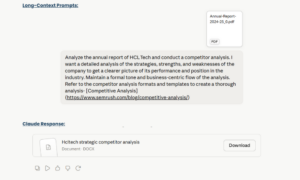
While working on lengthy and complex documents or reports, use long-context Claude prompts. For example, what you are actually looking for and what purpose. Make specifications and instructions clear, alongside adding tone, flow, or a certain approach you want responses in.
It will help the generative AI model to understand your query better and offer responses just the way you want. Additionally, give examples of your expected response for enhanced performance and highly accurate outputs. Here is a prompt example-
| “Analyze the annual report of HCL Tech and conduct a competitor analysis. I want a detailed analysis of the strategies, strengths, and weaknesses of the company to get a clearer picture of its performance and position in the industry. Maintain a formal tone and business-centric flow of the analysis. Refer to the competitor analysis formats and templates to create a thorough analysis- Competitive Analysis”
(Add File: Annual report of HCL Tech) |
|
View Claude's Response File: HCLTech_Strategic_Competitor_Analysis |
2. Role-Based Prompt:
Ask Claude to play a specific role to get the expected output. Enabling the AI model to adapt to a specific persona allows it to go beyond generic responses and embrace a personalized approach. The model will then understand a role and offer responses from the perspective of that role. It will incorporate the observations, potential, and thinking of the given role to process prompts and offer responses.
In this regard, a marketing head can create marketing reports personalized to their company’s needs, while an IT professional can generate strategic insights about IT frameworks. The prompt example here will be-
| “Act as the Senior Business Analyst of a tech company and analyze the annual report of HCL Tech and conduct a competitor analysis. I want a detailed analysis of the strategies, strengths, and weaknesses of the company to get a clearer picture of its performance and position in the industry.” |
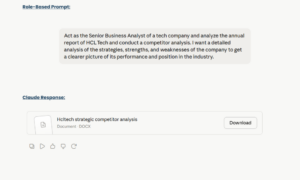
| View Claude's Response File: HCLTech_Strategic_Competitor_Analysis (1) |
3. Prompt for Iterative Refinement:
Claude’s responses can excel through a conversational flow of prompts. Here, you can adopt iterative refinement to enhance your prompt at every step and get even more appropriate responses. It helps fill the gaps in the primary response, such as readability, technical accuracy, strategic insights, and others. The approach offers polished responses that will resonate with your needs adequately.
| “Analyze the annual report of HCL Tech and conduct a competitor analysis. Make the company’s strategies, strengths, weaknesses, growth statistics, and other elements clear.”
“Maintain a formal and compelling tone for business presentations and easy adoption. Compare the strategies with other leading tech firms.” |
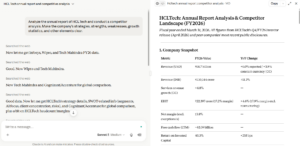
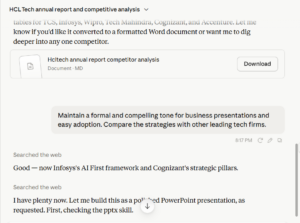
| View Claude's Response File: HCLTech_Competitor_Analysis_Presentation |
4. Constraint-Based Generation Prompt:
Individuals always have some limitations or constraints regarding which they want Claude responses. In this regard, instructing the AI model to follow a specific word limit, format, structure, and keywords can be highly instrumental. Such Claude Prompts generate action-driven responses, allowing users to take quick action with the output. Using constraint-based prompts saves time and delivers responses that require no revisions. For example,
| “Create a 1000-word article on quantum computing, maintaining the keyword 'importance of quantum computing' at 1% keyword density. It should include an introductory section followed by importance, challenges, use cases, recent developments, and future perspectives on quantum computing.” |
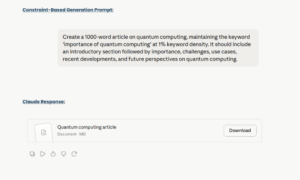
| View Claude's Response File: Quantum_Computing_Article |
5. Prompt to Control the Responses:
While integrating a conversational flow, users can control the responses of Claude with prompts. It offers more precision and enhances the output to act quickly. For example, you can instruct the model to use or not to use certain words, patterns, or flow. With this, you can control the responses and get expected outputs. Here is an example-
| “Create a 1000-word article on quantum computing with real-world insights and statistics.”
“Use standard paragraph breaks without unnecessary punctuation, hashtags, and quotations.” “Avoid using bold and italic letters.” “Do not use overly short bullet points.” |
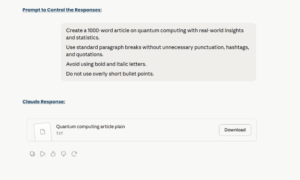
| View Claude's Response File: Quantum_Computing_Article_Plain |
6. Prompt for AI-Ready Document Workflows:
When a task depends on information buried in PDFs, forms, scanned files, or other unstructured content, first make the source material usable to AI. Tungsten Automation helps transform documents into trusted, structured information and route it through automated workflows. That gives Claude clearer context to work with and makes its outputs easier to apply in business processes.
A useful instruction is:
| “Identify the key fields, decisions, and missing information in these documents; return the results in a structured format and flag anything that requires human review.” |
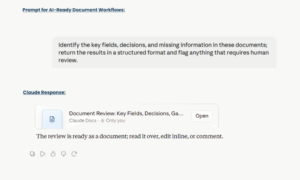
| View Claude's Response File: Document Review Key Fields, Decisions, Gaps and Human-Review Flags |
Claude’s Principles to Learn for Better Prompts:
Anthropic’s Claude has suggested major principles to craft effective prompts and get standard and accurate responses. Here is a glimpse-
- Use Clear and Direct Prompts: Using clear and explicit Claude prompts will help you get an appropriate response. Unclear prompts can lead to the generation of vague and inadequate outputs. So, clearly describe the desired structure and format, alongside constraints.
- Structure Prompts with XML Tags: Using XML tags in Claude prompts can help the AI model process complex instructions effectively. So, use tags for every variable, such as <context>, <example>, and <instructions>.
- Use Examples Effectively: Use 3-5 examples in prompts for better outputs. Ensure that the examples are relevant and diverse so that Claude can analyze and refer to the more effective ones.
- Define Your Context for Enhanced Performance: Ensure you define the context of your prompt and desired response. It helps Claude to understand your goals while generating personalized outputs.
Wrapping Up!
Claude is a superior AI model with enhanced capabilities across reasoning, coding, problem-solving, and multimodal abilities. Anthropic’s family of models includes Haiku, Opus, Fable, and Sonnet. The firm has recently introduced its latest and most agentic Sonnet model to date, Claude Sonnet 5. It is set to advance agentic capabilities for developers and coders.
However, users need to use diversified yet impactful prompts to unlock the complete potential of Claude models. Our guide to master Claude prompts offers an actionable approach to using the AI model for complex and personalized tasks. Notably, users may need to adopt a paid Claude plan to use these prompts without disruptions. Start using them today and redefine the way you interact with AI while driving more accurate, efficient, and meaningful outcomes across your workflows.
Learn about latest technologies and AI models for better usage and implementation with KnowledgeNile.
FAQs:
1. What are the best prompts for Claude AI?
Ans. Clear, precise, and context-driven instructions are the best Claude prompts.
2. Is Claude good for prompting?
Ans. Claude is exceptional at prompting, especially for complex tasks, reasoning, coding, problem-solving, and instruction-following.
3. What are examples of good prompts?
Ans. Good AI prompts clearly describe tasks, context, structure, format, and desired responses.
4. What are the 4 C’s of prompting?
Ans. Creativity, context, constraints, and clarity are the 4Cs of AI prompting.
Related Reads:
Anthropic’s Claude AI Now Generates Charts and Diagrams: What You Need to Know
Introducing Voiceprint, A New Claude Code Plugin That Can Clone Your Writing Style